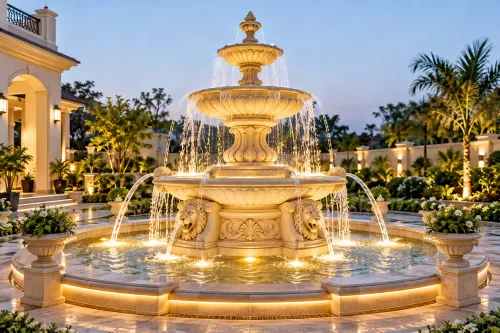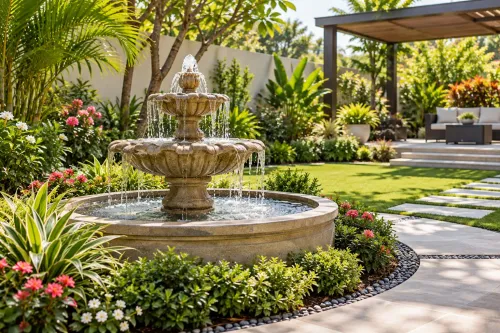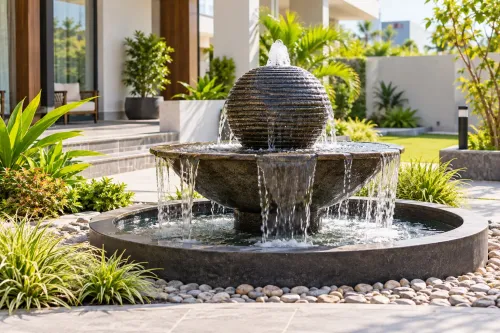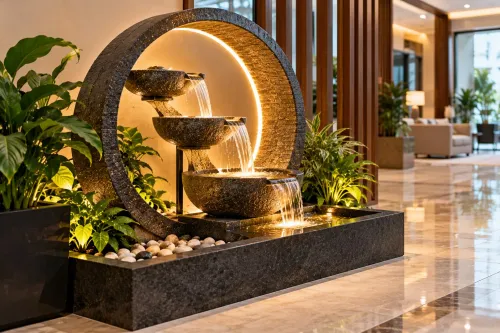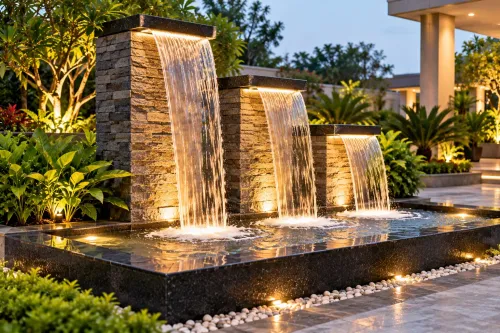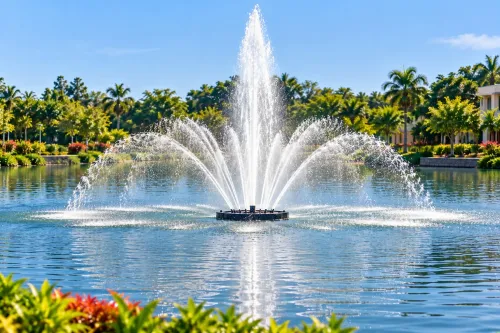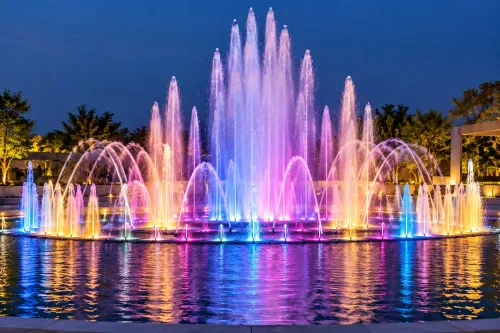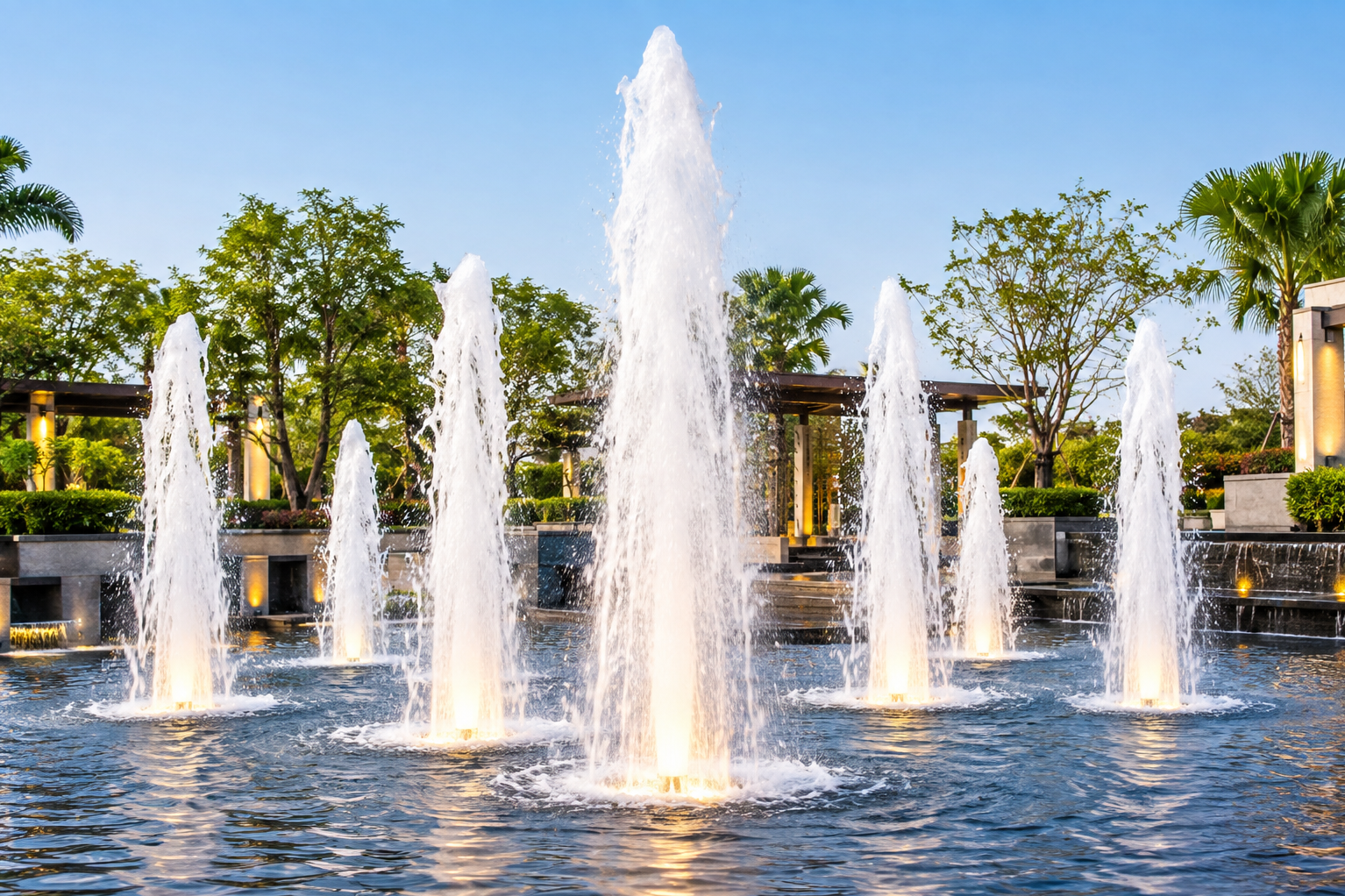
Jet fountains are among the most recognizable types of water features because they use controlled streams of water to create vertical, angled, circular, or combined patterns. Their apparent simplicity can be misleading, however. The final effect depends on nozzle selection, pump performance, basin dimensions, wind exposure, and viewing distance.
For landscape projects in Coimbatore, choosing the right jet configuration starts with the site.
Determine the Required Visual Impact
The first question is not how high the fountain can spray.
It is how the fountain needs to appear within its surroundings.
A large commercial entrance viewed from a road may need greater height and visual scale than a courtyard viewed from only a few metres away. Similarly, a public park can accommodate broader water patterns than a narrow hotel entrance.
Jet height should therefore be proportional to the site.
Choose the Pattern
Jet fountains can be configured in many ways.
Common design approaches include:
- Single vertical jets
- Multiple vertical jets
- Circular jet arrangements
- Angled jets
- Ring patterns
- Central jets surrounded by smaller effects
- Repeating linear patterns
Combining several nozzle types can create visual hierarchy, with one dominant water effect supported by smaller patterns.
Understand the Role of Pressure and Flow
A nozzle does not create the desired effect independently.
It requires suitable water flow and pressure from the pumping system. Pipe sizing, nozzle quantity, elevation, and hydraulic losses also influence performance.
This is why fountain design should consider the complete circulation system rather than selecting nozzles separately.
Check Basin Dimensions
Jet height and basin size need to work together.
If the basin is too small for the selected water pattern, splashing can increase. Wind can extend the distance water travels beyond the intended area.
Large outdoor projects should therefore consider local exposure carefully.
Open sites in and around Coimbatore may experience different wind conditions from enclosed courtyards, so the same jet configuration may not suit both environments.
Consider the Viewing Distance
Fine water details may look attractive close up but become difficult to distinguish from far away.
For large institutional campuses, commercial properties, hotels, resorts, or public landscapes, stronger patterns can provide better visibility from a distance.
Landscape designers should examine the feature from key viewpoints before deciding its final proportions.
Review Construction Readiness
Before ordering or installing the fountain, confirm that the site can support the intended system.
Useful readiness indicators include:
- Final basin dimensions are available
- Waterproofing strategy is defined
- Pump location has been identified
- Electrical provisions are planned
- Drainage is coordinated
- Piping routes are clear
- Lighting requirements are known
- Maintenance access is available
If several of these items remain unresolved, design coordination should continue before fabrication.
Ask for a Site-Specific Configuration
For larger projects, generic product selection may not be enough.
Providing the fountain manufacturer with architectural drawings, landscape layouts, basin dimensions, desired jet height, operating schedule, and photographs of the proposed area can make technical discussions more productive.
Royal Fountains & Equipments in Coimbatore can be considered when project teams are evaluating fountain manufacturing requirements for indoor and outdoor developments in Tamil Nadu.
The right jet fountains combine visual proportion with suitable hydraulic design. Architects, landscape designers, developers, and contractors should evaluate pattern, height, basin size, wind exposure, pump requirements, lighting, and service access together. Doing so helps turn a collection of jets into a coordinated landscape feature.
Keywords