A fountain that looks right in a sketch can overwhelm a courtyard, spray a façade, waste water or deliver an unstable jet once it is installed. You will be able to match the design to the site, calculate its operating requirements and prepare a practical brief for construction and maintenance.
Key takeaways
- Match fountain form to footprint, viewing distance, sound and pedestrian contact.
- Define the splash envelope before placing paving, seating or electrical equipment.
- Specify pump flow, head, nozzle type and filtration for the intended water effect.
- Put dimensions, materials, safety measures and maintenance access in the construction brief.
Choose the Fountain Form for the Outdoor Setting
A courtyard or terrace needs a compact, quiet form; a lawn, resort forecourt or public plaza can support a larger feature viewed from farther away. Choose the form by footprint, formality, viewing distance, pedestrian contact and sound, not by appearance alone.
| Option | Best setting | Footprint, character and operating behaviour |
|---|---|---|
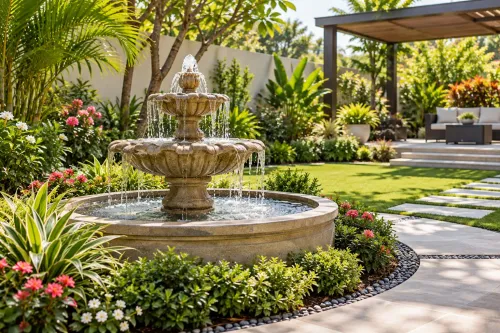
| Basin fountain | Courtyard, lawn or commercial frontage | A flexible formal feature with moderate footprint; suits close or distant viewing, but needs splash control beside walkways. |
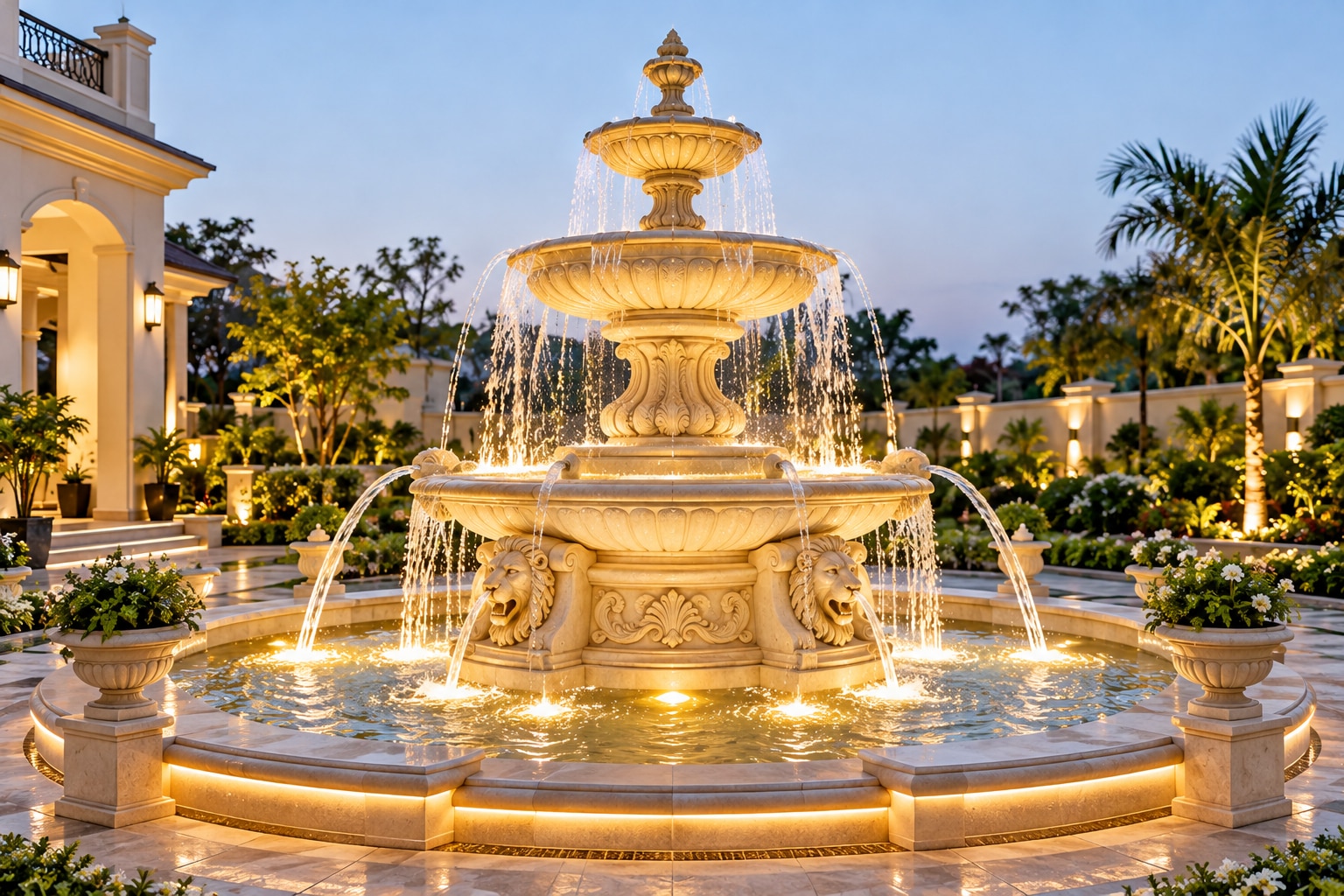
| Tiered fountain | Resort garden, civic lawn or grand entrance | Tall and traditional; needs surrounding space so people can see each level, approach safely and appreciate its vertical structure. |
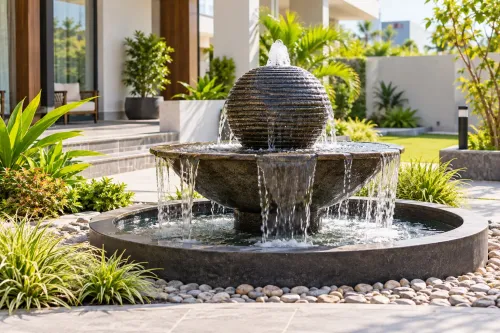
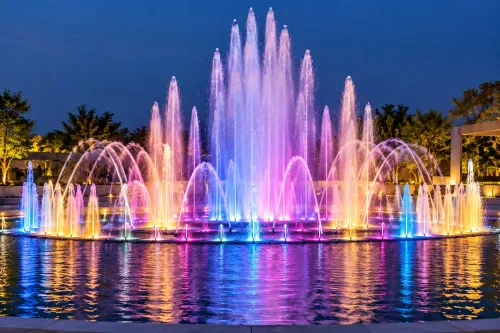
| Ring fountain with centre jet | Visible central position in a formal lawn or plaza | Requires generous setback and rewards radial symmetry; the circular spray is unsuitable beside narrow paths, strong crosswinds or drift-sensitive equipment. |
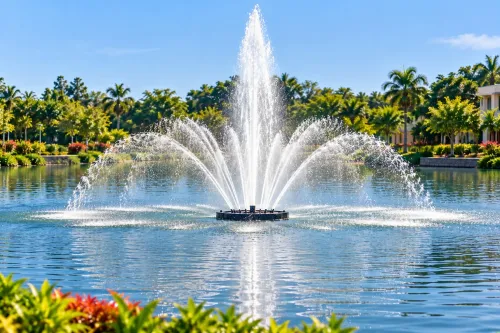
| Centre jet | Lawn, roundabout or open forecourt | Reads clearly from a distance and creates a strong vertical focus, but wind increases drift and noise. |
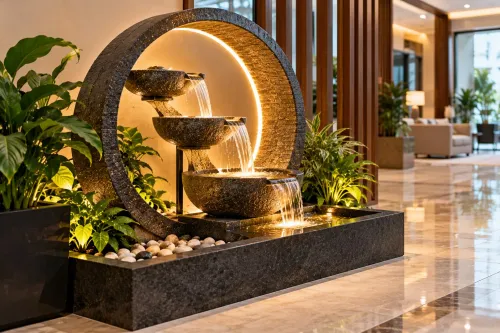
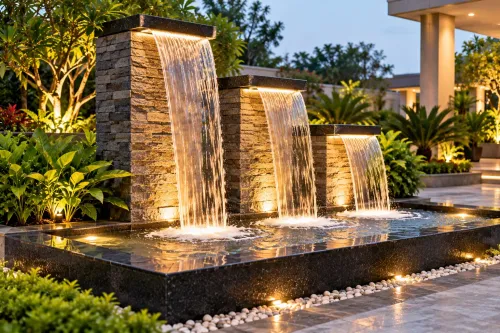
| Wall fountain | Narrow entrance, terrace or confined courtyard | Uses little floor area, gives a controlled viewing direction and places sound close to the listener without spreading spray across circulation routes. |
| Bubbling urn | Terrace, entrance or intimate courtyard | Low splash profile, gentle sound and close viewing make it safer near pedestrians and finishes. |
| High-foam jet | Resort arrival court, frontage or public focal point | A bold, visible effect that needs stricter splash control, cleaning and nozzle maintenance than a quiet bubbling form. |
A high-foam jet is the wrong choice where maintenance access is restricted or nearby paving must remain dry. For public spaces, separate pedestrian routes from spray and provide access to strainers, pumps and controls without entering the basin.
Set Scale, Viewing Distance and the Splash Envelope
Match fountain scale to the distance from which people will see it, not to the model that looks impressive in a catalogue. As a starting proportion, make the visible basin diameter about one-quarter to one-third of the main viewing distance, then adjust it to the building frontage, available footprint and planting.
A tall jet should occupy the façade visually without reaching its windows or roofline.
| Viewing condition | Starting proportion | Main design risk |
|---|---|---|
| Driveway or plaza focal point | Larger basin and taller jet, visible from 10–30 metres | An undersized feature disappears beside a façade or lawn |
| Courtyard or terrace | Compact basin, lower jet, close-range detail | An oversized jet dominates seating and wets nearby surfaces |
| Narrow entrance | Width limited by paving and walls; keep spray inside the route | Wind drift reaches doors, walls and pedestrians |
A fountain design for courtyard use needs a tighter envelope than a focal fountain across a plaza. Draw the jet height, its falling trajectory, fountain spray radius, wind drift and clear space around the basin on the plan; include paving, walls, paths, planting beds and electrical cabinets.
Overscaled jets wet all of them, while fine mist travels farther than the visible splash.
Set basin depth from the operating water level, not the shell’s total depth. Leave freeboard for splash-out and wind-driven displacement, plus room below the intake for pump submergence, drawdown, filter cleaning and maintenance drainage.
Size the reservoir so these allowances do not expose the intake, and provide overflow and makeup-water control for losses from evaporation, leaks, splash-out and wind.
Specify the Hydraulics Behind the Intended Visual Effect
Start with the pump curve at the calculated total dynamic head, not the advertised maximum flow at zero head. Calculate elevation, pipe and fitting losses, filter resistance, valve losses and the pressure required at the nozzle, then select the fountain pump flow rate at that operating point.
A pump that meets its rating only at zero head will underperform after installation.
Specify nozzle geometry and fountain nozzle pressure together. Pressure changes jet height, trajectory, sheet thickness and splash behaviour; two nozzles with the same nominal diameter can produce different effects at the same flow. Basin depth must maintain intake submergence without drawing air, while fountain pipe diameter must carry the design flow without excessive friction.
Match the hydraulic duty to the visual effect:
- Ring jets need balanced flow around the loop, stable pump head and evenly sized outlets.
- Central jets need sufficient pressure for height; excessive pressure increases drift and splash.
- Sheet nozzles need clean, steady flow and carefully controlled pressure for an unbroken curtain.
- Aerated nozzles mix air into the stream, increasing apparent volume and turbulence.
- High-foam nozzles need generous flow, controlled pressure and space for splash and foam collapse.
Protect delicate effects with an accessible strainer, isolation valves and removable nozzle bodies. Undersized suction piping, abrupt elbows, air entering the line, blocked strainers or a pump operating away from its efficient range will create wavering or broken laminar jets. Fine passages also magnify debris, scale and algae problems, so specify a realistic cleaning interval.
Design for Water Use, Weather, Safety and Maintenance
Before construction, resolve the water source, discharge route, operating hours, climate, treatment method, access for cleaning and the consequences of a failed control or pump.
| System | Water path | Design burden |
|---|---|---|
| Recirculating fountain | Reuses treated basin water | Provide filtration, makeup water, cleaning and water-quality control |
| Once-through fountain | Continuously consumes fresh water | Provide supply capacity, drainage and legal discharge capacity |
Build a daily loss budget rather than sizing makeup water for evaporation alone. Estimate volume from:
- Evaporation
- Splash-out
- Wind drift
- Leaks
- Filter cleaning
- Drain-down
- Overflow
Install a makeup meter, level alarm or flow monitor that flags consumption above the calculated range.
Fountain water treatment must control scale, biofilm, corrosion and suspended solids without attacking basin finishes, seals, stainless steel, elastomers or nearby planting. Poor control clogs fine nozzles, shortens pump life and clouds underwater lighting.
Spray, mist and aerosol require Legionella fountain safety planning. Address stagnation, water temperature, cleaning, disinfection and maintenance in the site water-management plan; a decorative fountain is not maintenance-free.
Classify an interactive fountain under the local aquatic-venue code before selecting circulation, filtration, disinfection, testing, operator controls and user protection. Its classification can impose different requirements from a non-contact basin.
Coordinate fountain-rated underwater luminaires and listed equipment with the applicable electrical code, including bonding, grounding and ground-fault protection. In freezing climates, drain low points, manifolds, filters, valves and lighting niches—not only the basin—and define isolation and restart procedures.
Turn the Design into a Comparable Construction Brief
Approve a custom outdoor fountain only after the design is converted into a measurable fountain design brief. A rendering shows appearance; construction documents must show water movement, clearances, connections, equipment performance and the work required when something fails.
Use this fountain contractor checklist:
1. Request a scaled plan identifying the basin, operating water level, freeboard, pump submergence, spray envelope, planting setbacks, pedestrian clearances, overflow route and makeup-water connection. Without these dimensions, wind-driven spray can reach paving, façades, planting or electrical equipment.
2. Require the pump curve at the calculated total dynamic head, including elevation, pipe and fitting losses, filters, valves and nozzle pressure. Record design flow, nozzle model, nozzle pressure, pipe diameters, filter arrangement and expected sound level at occupied areas. A zero-head flow figure will not predict installed performance.
3. Ask how the system responds to wind, algae, mineral deposits, abnormal water loss, cleaning chemicals, lamp or LED-driver replacement and seasonal shutdown. Require a loss alarm or defined response when the basin level falls unexpectedly.
4. Specify flexible connectors, resilient equipment mounts and properly supported pipework wherever vibration could enter the basin, structure or occupied spaces. Rigid connections can transmit pump noise farther than the motor itself.
5. Put fountain maintenance access on the drawing: pump extraction, strainer cleaning, zone isolation, basin drainage and control access must not require dismantling finished landscaping or entering the water.
Royal Fountain Designs from Royal Fountains & Equipments - 08043694426 can be assessed against this evidence, comparing documented site fit, hydraulics, safety controls and maintenance tasks rather than decorative styles.
Related products
 | / garden fountain : this beautiful fountains are the most pleasant sight for your eyes, ears & of course for your soul too. View product → |
 | Traditional Ring Fountain with Center Jet Spray rings are constructed of stainless steel pipes in a variety of diameter and orifice sizes. View product → |
Frequently asked questions
How do you choose a fountain form for an outdoor setting?
Match the form to the available footprint, viewing distance, desired formality, pedestrian contact and acceptable sound level. Compact courtyards suit quieter forms, while lawns, resort forecourts and public plazas can support larger features viewed from farther away.
What is a fountain splash envelope?
The splash envelope is the area where wind, jet height and falling water can carry droplets. Define it before locating paving, seating, entrances, electrical equipment or surfaces that become slippery when wet.
What hydraulic details belong in a fountain design?
Specify the visual effect first, then document pump flow, total head, nozzle type, jet height, pipe sizes, filtration and control requirements. These details make the design measurable and easier to compare between suppliers.
What should a fountain construction brief include?
Include the footprint, basin or tank dimensions, materials, water treatment, pump and nozzle schedule, splash limits, drainage, electrical protection, access panels, cleaning method and maintenance frequency.