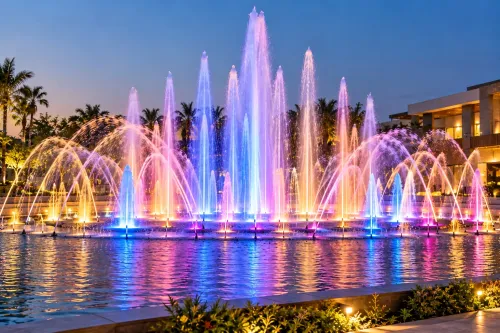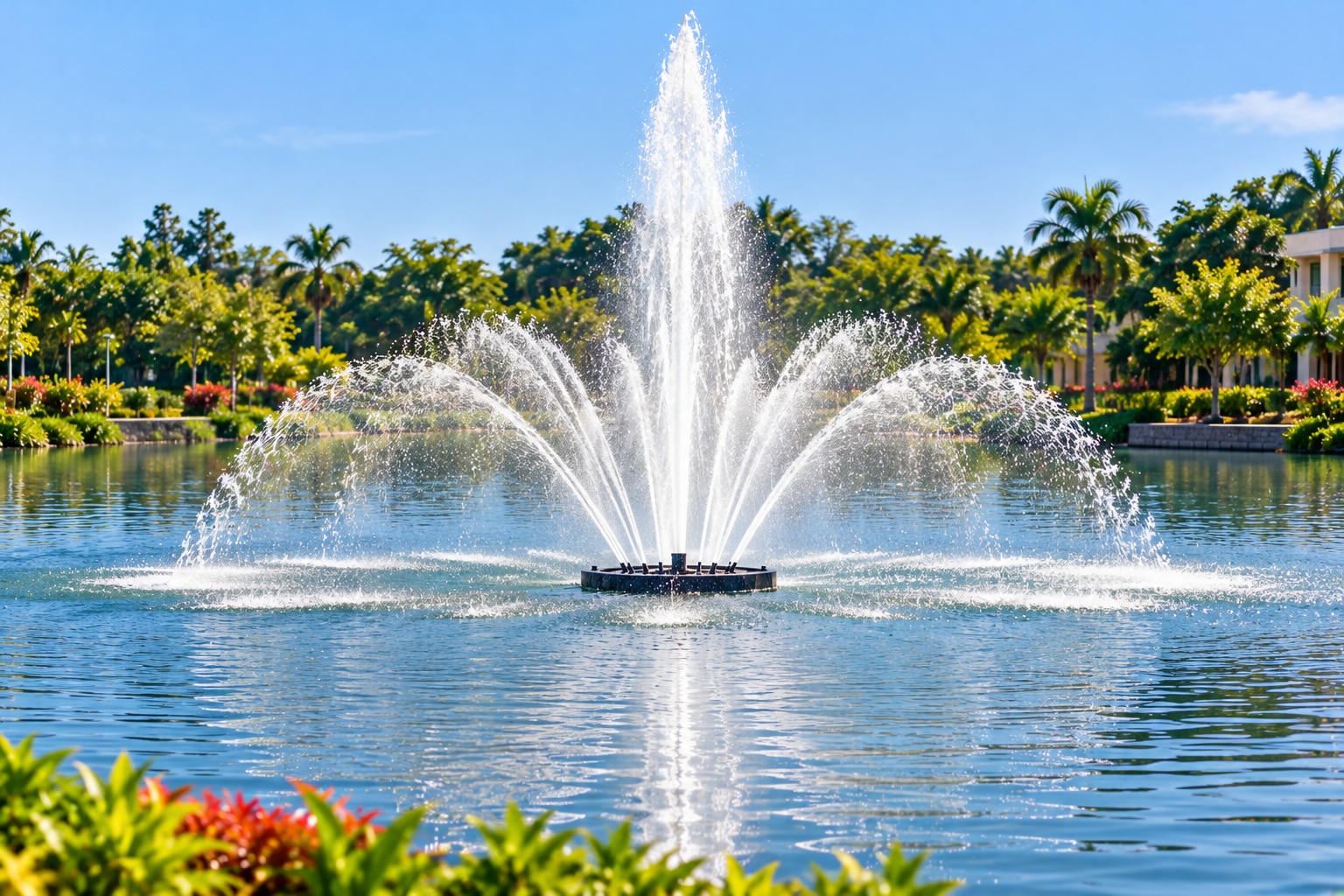
A floating fountain that looks impressive in a calm photograph can perform poorly when wind, weeds, silt, changing water levels and long electrical runs enter the design. You will be able to screen a site, specify the hydraulic and electrical requirements, plan anchoring and installation, and judge whether the finished system meets its visual, safety and water-quality objectives.
Key takeaways
- Measure depth, water-level changes, wind exposure and access before selecting equipment.
- Match pump capacity and nozzle type to the intended spray height and pattern.
- Use engineered moorings and protected electrical systems for open-water conditions.
- Budget for cleaning, inspections, water-quality issues and seasonal shutdowns.
Check the Water Body Before Choosing a Fountain
A lake, pond or large water body is suitable for a floating fountain when it has enough depth, stable water levels, manageable wind and wave action, and safe access for installation and maintenance. Record these facts before comparing fountain models.
- Water depth at the proposed location and the manufacturer’s minimum operating depth; shallow water can expose the intake, draw silt into the pump or ground the platform.
- Lake surface area, shoreline setbacks and the intended viewing zone.
- Wind exposure and fetch, including prevailing direction, maximum operating wind and open-water distance; wind can bend the plume, carry spray onto paths and increase mooring loads.
- Wave action, seasonal water-level variation, ice risk and current.
- Access for a crane, boat, lifting equipment, electrical cable route and future retrieval.
- Leaves, filamentous algae, plastic litter, fish and wildlife activity near the intake; specify screen area, geometry and cleanout access with the seasonal debris load.
| Site condition | What it means | Decision |
|---|---|---|
| Sheltered pond with stable depth | Lower wave and wind loads | A floating fountain is usually practical |
| Exposed lake with long fetch | Greater plume drift and mooring forces | Require wind-based hydraulic and anchoring design |
| Shallow or fluctuating water | Intake blockage, grounding or cable strain | Reject the location or redesign the platform and mooring |
A decorative fountain is not automatically a lake-aeration system. Its oxygen transfer stays concentrated near the surface, so low dissolved oxygen at depth or thermal stratification calls for a bottom-diffused-air system or dedicated destratifier assessment. In freezing climates, also decide whether to remove the unit or protect it under an engineered de-icing plan.
Match Pump, Nozzles and Platform to the Display
Size the pump at the required operating point: the specified flow rate and spray height must intersect the pump curve at the actual total dynamic head, not at the advertised zero-head flow. Calculate total dynamic head from:
- Nozzle elevation above the water surface
- Discharge-pipe friction
- Elbows, valves and fittings
- Intake-screen and filter losses
- Any elevation difference between the water and equipment
Choose the nozzle diameter for the intended pattern at that operating point. A small orifice produces a finer plume but clogs faster with mineral scale, biofilm or suspended solids; a larger orifice tolerates poorer water quality but looks less delicate.
Do not use chemical treatment to compensate for an undersized intake screen or an impractical cleaning routine.
Size the floating platform for the pump, motor, pipework and cable weight, with reserve buoyancy after installation. Its footprint must resist tipping when wind bends the plume or spray loads one side.
Size the intake area to keep entrance velocity and suction loss low, then provide access for removing leaves, filamentous algae and litter; a finer screen is not automatically better.
Ask Royal Fountains & Equipments - 08043694426 to document the selected flow, head, nozzle diameter, motor current and platform reserve before fabrication. Test the finished display under representative wind and record spray drift, voltage and running current, not just its calm-weather height.
Related products
 | Floating fountains are a type of fountain applicable in any water park or lakes. They are a developed version of ring fountains. View product → |
 | Decorative Floating Fountains Our floating fountain is a unique type of fountain in a lake to float up and down as the water level changes that uses a pump and has some aeration... View product → |
Design Moorings and Electrical Protection for Open Water
Anchor sizing starts with wind load, not the float’s dead weight. Floating fountain anchoring must resist drag from the platform, motor housing, plume, cables, waves and current, with allowance for water-level changes, cable angle, corrosion and inspection access. A mooring layout that works in a sheltered pond can fail on an exposed lake.
Specify the mooring design to include:
- Anchor positions and capacities calculated for the site’s wind, current, fetch and maximum operating condition.
- Cable or rope material, breaking strength, connectors and abrasion protection suited to permanent immersion.
- Enough slack for water-level variation without allowing the unit to drift into boats, banks or public areas.
- Inspection points that let you check anchors, shackles, floats and cable wear without entering unsafe water.
Wind also changes the fountain itself. Set an operating wind limit, measure spray drift against paths and electrical enclosures, and keep the plume within its safe setback. In freezing climates, remove the unit, lower it to protected depth, or use an engineered de-icing system; switching off the pump does not prevent ice damage.
Treat shore power as a wet-location installation. Use listed equipment, protected cable routing, a lockable disconnect, voltage-drop checks, bonding and earthing and residual-current protection sized under the locally adopted electrical code.
Secure the cable so movement cannot pull the motor connection, and protect the pump with an accessible intake screen, overload protection and a cleanout plan.
Plan Transport, Installation and Performance Testing
Treat commissioning as a lifting and electrical job, not a launch. Before the crew arrives, book a rated crane or workboat, lifting frame, certified slings, a service platform or boat, and a shore landing area that supports the delivery vehicle.
Confirm permits, weather limits, exclusion buoys, emergency shutdown access and a clear route for fountain transport and lifting.
- Inspect the float, pump, nozzles, lights and cable glands for transit damage. Verify lifting points and record the equipment serial numbers.
- Lift the assembled unit from a stable access point. Keep personnel outside the suspended-load zone and use tag lines to control rotation.
- Position the float in the marked operating area, connect moorings, and check that anchors, shackles and lines are seated without crossing the intake.
- Complete cable routing from the fountain to the shore panel. Protect cables from abrasion, boat traffic and public contact; check conductor size and voltage drop for the full run.
- Connect wet-location equipment, grounding and bonding, ground-fault protection, and a lockable disconnect. Test the emergency shutdown before energising.
- Run a performance acceptance test at representative water level and wind. Record motor voltage, running current, practical flow or pressure, plume geometry, spray encroachment, noise at receptor locations, ground-fault operation, and anchor and cable condition. Measure dissolved oxygen at specified depths when aeration is part of the brief.
Accept the installation only when measurements meet the design brief and local electrical code. A visible plume alone does not prove safe hydraulic, electrical or water-quality performance.
Budget for Water Quality, Maintenance and Seasonal Shutdown
The real operating cost starts with the run schedule, not the motor rating. Budget separately for:
- Electricity at the measured running current, local tariff, daily runtime and lighting load.
- Intake screen cleaning after leaf fall, plastic accumulation or filamentous algae; a finer screen clogs faster and raises pump suction loss.
- Inspection of pump seals, cables, cable glands, floats, moorings, anchors and control-panel ground-fault protection.
- Nozzle scale and algae removal, plus replacement nozzles when orifices enlarge, clog or lose their intended pattern.
- Access costs, including a boat, lifting equipment, service crew and safe isolation before entering the water.
- Pump wear, submerged light failures and mineral-coated lenses, which add labour as well as parts.
- Water testing and any approved treatment plan; circulation does not remove nutrients or reliably control a toxic algal bloom.
Measure dissolved oxygen at the depths named in the performance brief. A surface fountain can add oxygen near the top without correcting deep low oxygen or thermal stratification; whole-water-column treatment may require diffused air or a destratifier.
Plan a monsoon and winter shutdown rather than leaving equipment to fail in severe conditions. Record the removal date, rinse and dry pumps and lights, protect cables and nozzles, inspect floats and moorings, and store removable equipment above flood or freezing exposure.
Include restart inspection, re-priming where applicable and a post-start current, spray-pattern and dissolved-oxygen check.
Frequently asked questions
What should you check before choosing a floating fountain?
Record water depth, seasonal water-level changes, wind and wave conditions, and safe routes for installation and maintenance.
How do you match a pump and nozzle to the display?
Define the required spray height, pattern and viewing distance, then select a pump, nozzle and platform designed to deliver that display together.
How should a floating fountain be secured in open water?
Use a mooring arrangement suited to the water body's depth, wind and wave forces, and protect electrical connections against water exposure and physical damage.
What maintenance costs should you plan for?
Allow for nozzle and intake cleaning, pump inspections, water-quality problems, access equipment, electrical checks and seasonal removal or shutdown.
Related products
 | Multiple Floating Jet Fountains Multiple Floating Jet Fountains can be purchased from us in different design options. These fountains eject multiple splashes of water into the air, which look extremely engaging... View product → |
 | Artificial Waterfalls We offer an exuberant range of Fountain Waterfall that are built in round form. View product → |