The best outdoor fountain depends less on appearance than on the site: available space, viewing distance, wind, drainage, water supply, electrical capacity and the people moving around it. By the end, you will be able to match a fountain type, scale, pump and material to a garden, hotel, office campus, mall, resort or public plaza.
Key takeaways
- Use low, intimate fountains for gardens and visible, controlled features for commercial areas.
- Size jets for viewing distance, wind exposure and pedestrian traffic.
- Select pumps at the required flow rate and head, not maximum rated output.
- Specify non-slip surfaces, splash control, drainage and accessible maintenance points.
Match the Fountain Type to the Site and the Experience
A garden usually suits a low, intimate feature; a commercial area needs stronger visibility, simpler circulation and greater control of splash and noise. Match the fountain to the experience before choosing its appearance.
| Type | Best fit | Watch for |
|---|---|---|
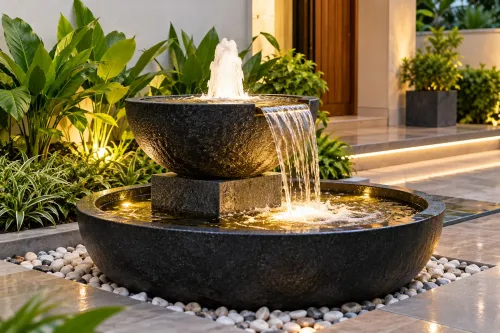
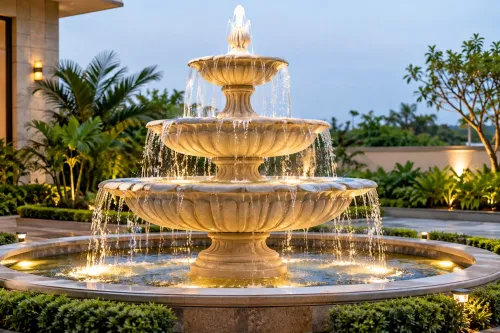
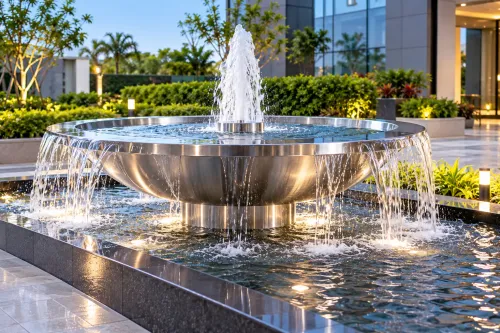
| Basin fountains | Garden focal points, hotel entrances and courtyards where visitors view water from several sides | They need a clear footprint, safe edges and frequent removal of leaves |
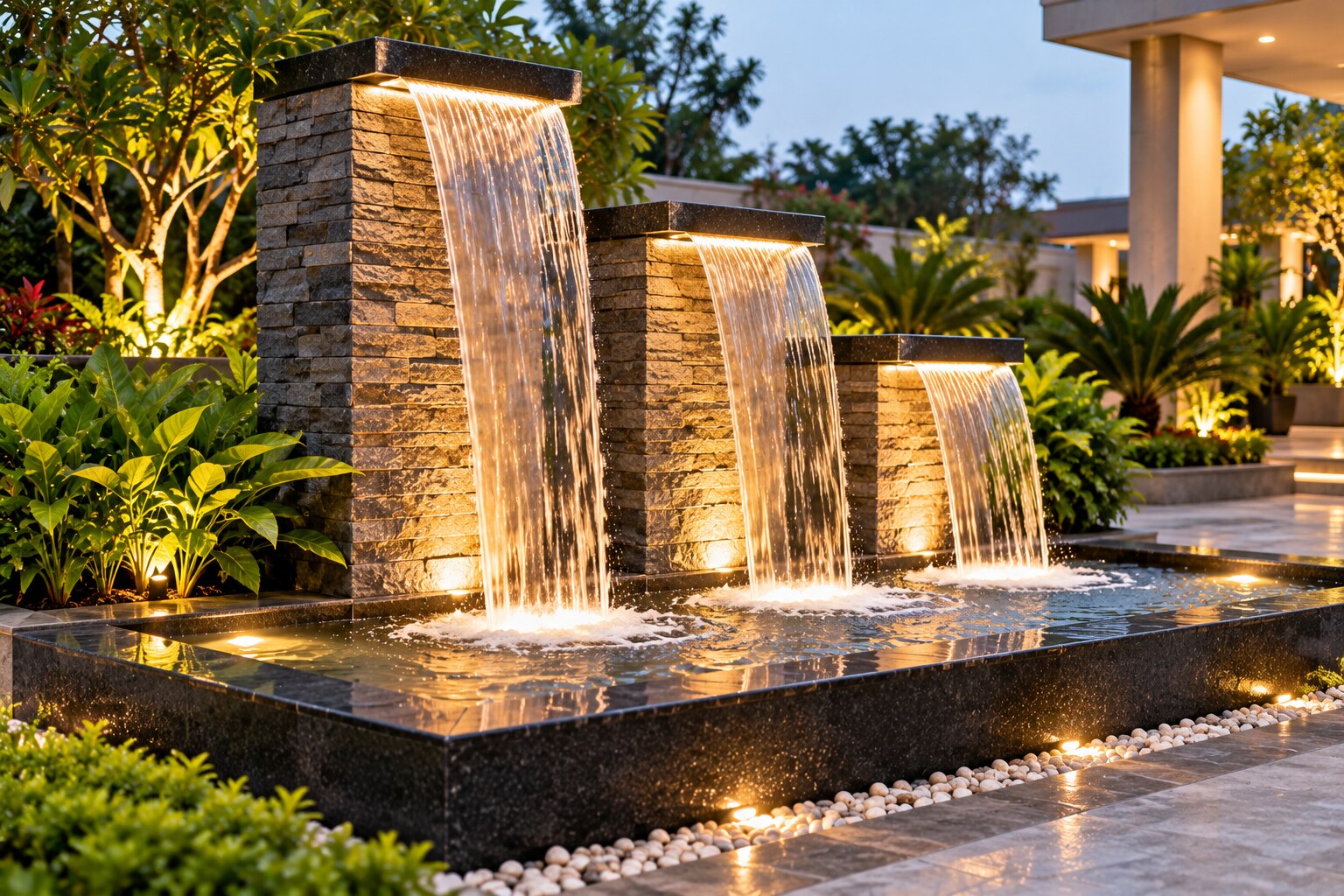
| Waterfalls | Resort landscapes, sloped gardens and shaded areas seeking natural sound and texture | Splash, algae and uneven ground demand careful drainage |
| Bubbling features | Small gardens, office courtyards and low-noise reception spaces | Their low profile disappears when the viewing distance increases |
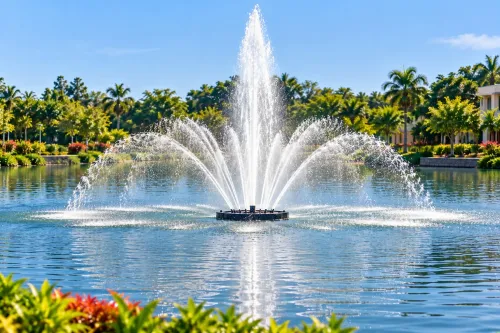
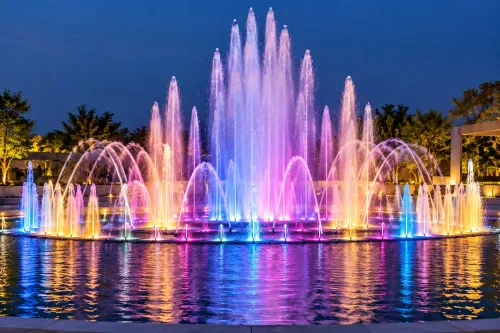
| Jet fountains | Malls, plazas and civic spaces requiring a visible landmark from far away | Wind can distort the plume and wet pedestrian routes |
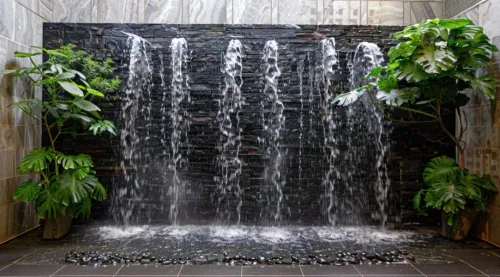
| Wall fountains | Narrow courtyards, entrances and sites with limited floor area | The wall needs structural support and protection from staining |
| Stream-style installations | Large gardens, campuses and resorts that benefit from a journey through the landscape | They require more land, grading and controlled overflow |
For a home garden, choose bubbling features or a compact basin fountain when seating is close and noise must stay low. Use waterfalls where shade, drainage and natural planting support the setting.
For a hotel, mall or public plaza, jet fountains and broad basin fountains create a stronger arrival experience. Confirm viewing distance, pedestrian flow, wind exposure, electrical supply and water access before fixing the design.
Size the Fountain for Viewing Distance, Wind and Traffic
A garden fountain viewed from 3–6 metres needs a compact silhouette; a plaza feature viewed from 20–40 metres needs greater height, diameter and contrast. Treat the figures below as starting dimensions, then verify the nozzle’s flow and pressure, wind drift, splash zone and surrounding sightlines.
| Site | Fountain scale and viewing distance | Starting jet height | Starting basin diameter |
|---|---|---|---|
| Home garden | Compact focal point, viewed from 3–6 m | 0.6–1.5 m | 1–2.5 m |
| Hotel entrance | Strong arrival feature, viewed from 8–15 m | 1.5–3 m | 3–6 m |
| Office campus | Legible from paths and upper floors, viewed from 10–25 m | 1.5–4 m | 4–8 m |
| Mall or public plaza | Large visual anchor, viewed from 20–40 m | 2.5–6 m | 6–12 m |
Wind-exposed sites need lower-profile jets or automatic height reduction; a tall plume that looks impressive in still air can wet paving, overload drainage and lose water through drift. Keep the splash zone outside pedestrian routes, accessible clear areas and building entrances.
For narrow footprints, wall fountains concentrate the view vertically, but size the catch basin to contain rebound and splash. Stream-style installations need more length and grade than height, so size their channel for the intended viewing distance and provide safe edges beside pedestrian traffic.
Specify every nozzle at its design pressure and flow, not by catalogue height alone. Turbulence, water quality and submergence can change the finished pattern. A larger basin also adds maintenance time, water volume and structural load.
Specify the Water System and Pump at the Operating Point
Select the pump at the installed operating point, not its maximum flow rating. A pump that produces the specified flow only at zero head will deliver a weak plume after installation. Give the nozzle a design pressure and flow; height and pattern depend on those values.
Wind can alter the result, while turbulence, submergence and water quality add further uncertainty.
Use these inputs in the pump calculation:
- Nozzle flow and pressure at the required visual effect
- Static lift from water level to nozzle
- Pipe friction and losses through fittings, valves and filters
- Elevation changes and the resulting total dynamic head
| Option | Water arrangement | Running-cost consequence |
|---|---|---|
| recirculating fountains | Basin water returns to the pump | Lowest water demand, with evaporation and splash loss still requiring replacement |
| make-up-water system | Fresh water enters through a float valve or solenoid | Controls level but increases metered-water use |
| drain system | Water leaves through a drain or overflow route | Simplifies flushing but raises water and discharge costs |
Fine filtration protects small nozzle passages but adds pressure loss. Size the screen or strainer for the smallest passage and provide accessible cleaning or differential-pressure indication; an element that is too fine shifts the pump away from its design point as it loads.
Variable-speed control reduces energy at partial output: flow falls roughly with speed, head with speed squared and power with speed cubed. Keep the pump above its minimum cooling and stable-operation limit. A low-water cutoff protects against dry running, but level alarms and leak checks are still needed.
Choose Materials, Finishes and Controls for Outdoor Exposure
Reliability starts with a material specification matched to chloride, water chemistry, freezing and maintenance—not with appearance alone. Use stainless steel 304 for ordinary outdoor exposure, but choose stainless steel 316 near salt air, chlorinated splash or de-icing salts; its molybdenum improves resistance to chloride pitting. Neither grade survives stagnant, concentrated chlorides indefinitely.
| Material | Strength | Protection required |
|---|---|---|
| Stainless steel 304 | Cost-effective for low-chloride sites | Clean welds, remove carbon-steel contamination and avoid crevices |
| Stainless steel 316 | Better chloride resistance | Rinse deposits, clean welds and prevent stagnant pockets |
| Brass | Warm appearance for fittings and accents | Confirm water compatibility and isolate dissimilar metals |
| Stone fountains | Natural, durable visual finish | Use compatible sealer, joints, drainage and freeze protection |
Acidic water attacks carbonate stone and cementitious surfaces. Water trapped in cracks freezes, expands and causes scaling or spalling, so slope surfaces to drain, seal suitable joints and winterize the basin before freezing weather.
Specify controls for wet locations, with grounding, bonding and GFCI protection coordinated with the applicable edition of NEC Article 680 and local inspection rules. Add a metered makeup-water connection, overflow route and low-water cutoff.
The cutoff protects the pump; it does not detect a slow leak, so include level alarms and test every float, probe and solenoid during commissioning.
Build Safety and Maintenance into the Commercial Specification
Specify the failure controls before choosing finishes. For fibreglass, resin, concrete and glass fountains, document safe access, isolation points, drainage, water treatment and replacement parts; a beautiful installation becomes a liability when technicians must enter standing water or dismantle paving to reach a pump.
- Keep adjacent paving slip-resistant and grade it away from pedestrian routes. Define splash-zone control with jet limits, wind shutdown settings and an overflow route.
- Provide grilles, sumps and nozzles with anti-entrapment protection, plus lockable covers and isolation valves for every pump circuit.
- Have an electrician coordinate grounding, bonding, wet-location equipment, GFCI and residual-current protection with the adopted NEC Article 680 edition and local inspection requirements.
- Add a metered makeup-water connection, low-level protection, drain, filter access and labelled cleaning points. Do not rely on manual hose filling.
- For interactive or spray-contact features, identify the health authority’s rules before specifying treatment. Check the CDC Model Aquatic Health Code where it applies, and use NSF/ANSI 50 as an equipment reference for recreational-water facilities—not as universal approval for decorative components.
Royal Fountains & Equipments - 08043694426 can add value by converting the site survey into coordinated hydraulic, electrical and access drawings, then matching service clearances and control logic to the chosen feature. Require commissioning records, pump operating data, water-treatment settings and a planned inspection schedule at handover.
Related products
 | / garden fountain : this beautiful fountains are the most pleasant sight for your eyes, ears & of course for your soul too. View product → |
 | Artificial Waterfalls Our domain expertise allows us to offer an enticing range of Garden Waterfalls. View product → |
Frequently asked questions
Which fountain type suits a garden?
Choose a low, intimate feature that fits the garden’s scale, viewing distance and desired sound level.
How should you size an outdoor fountain?
Size the basin and jets for viewing distance, wind exposure, pedestrian traffic, splash limits and noise.
How do you choose the right fountain pump?
Select a pump at its operating point by matching required flow rate and total head, including pipe losses.
What materials and controls suit outdoor fountains?
Specify materials and finishes that tolerate outdoor exposure, along with controls for schedules, flow adjustment and protection.
What safety features should commercial fountains include?
Include slip-resistant circulation areas, controlled splash, drainage, safe electrical access and maintenance points in the specification.
Related products
 | High Foam Jets Fountains We bring forth for our clients a superior quality range of High Foam Jets Fountains which is creatively designed by our designers using high-grade... View product → |
 | Product Details: Material Stainless steel or brass Type Stone Garden Products Design OEM View product → |
 | Indoor Fountains Manufacturer This fountain perfectly crafted with combination of durable poly resin, stone powder and fiber glass for lasting quality creates a realistic, natural... View product → |