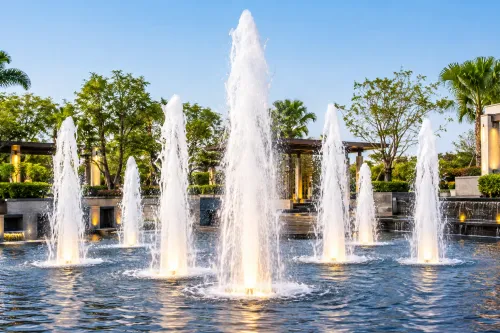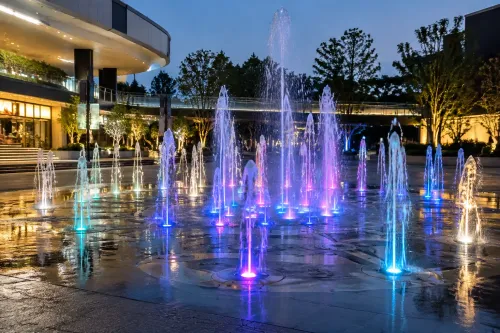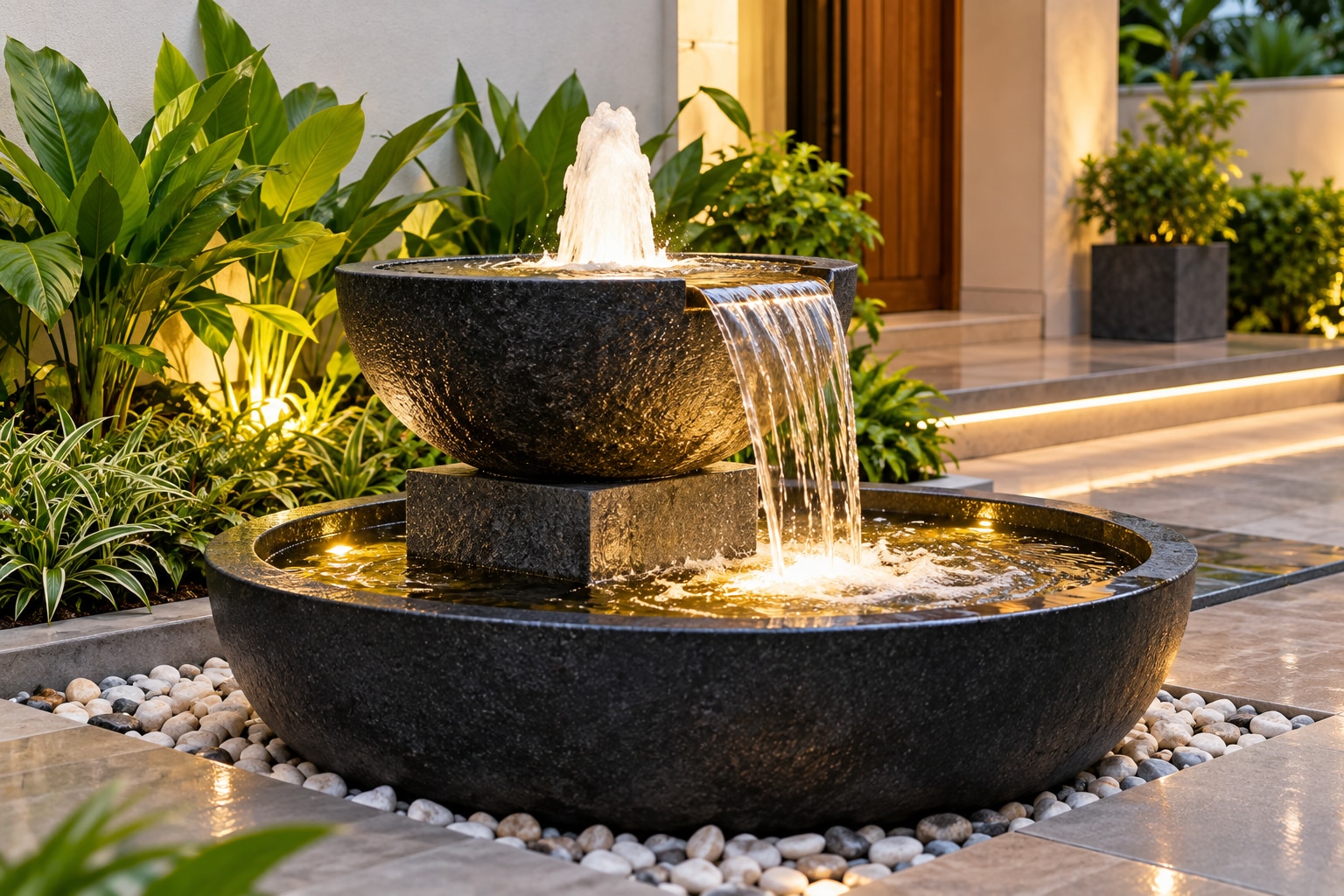
The right fountain must fit the room or site, operate safely, remain audible only at the level you want, and stay serviceable after installation. By the end, you will have a practical way to measure the space, compare fountain systems, check technical specifications, and decide whether a standard or customised feature is appropriate.
Key takeaways
- Measure the fountain footprint, height, splash zone and service access before buying.
- Match pump flow, electrical load and water capacity to the installation site.
- Choose water patterns and sound levels that suit viewers, neighbours and safety needs.
- Include climate exposure, cleaning, drainage and repair access in the total cost.
Match the Fountain Type to the Location and Available Space
A fountain works only when its footprint, height and splash zone fit the space—not merely its visible bowl. Measure the usable length and width, ceiling clearance, viewing distance, filling route and the clear area needed to reach the reservoir, pump and drain.
Keep cable routes out of walkways and leave service access instead of pushing the feature against a wall.
Before choosing a form, record:
- The base footprint, including the pump housing and any control box
- Total height to the highest water point, with clearance from ceilings, signs and branches
- Splash and wind-drift distance beyond the basin or wall
- Viewing distance from entrances, seating and circulation paths
- Room to remove filters, lift the pump and clean the reservoir without dismantling the feature
| Type | Space requirement | Best fit and limitation |
|---|---|---|
| Tabletop fountain | Stable surface with nearby refill access | Desk, reception counter or small indoor area; limited water volume and splash tolerance |
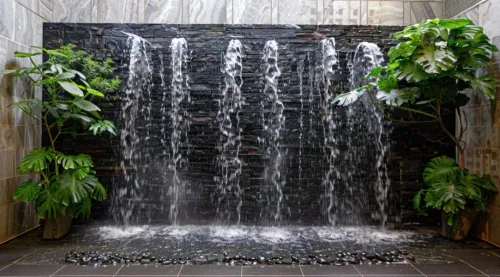
| Wall-mounted fountain | Strong, water-protected wall and floor clearance | Narrow corridors or foyers; requires concealed drainage and service access |
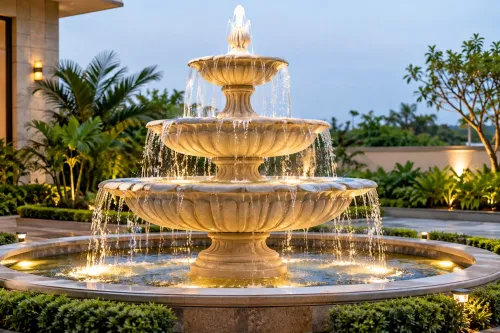
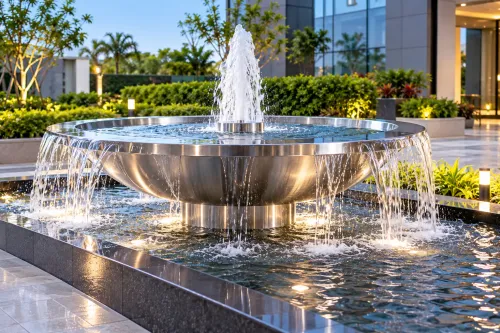
| Freestanding fountain | Clear floor footprint and surrounding splash margin | Lobbies, courtyards and plazas; needs protection from knocks and wind |
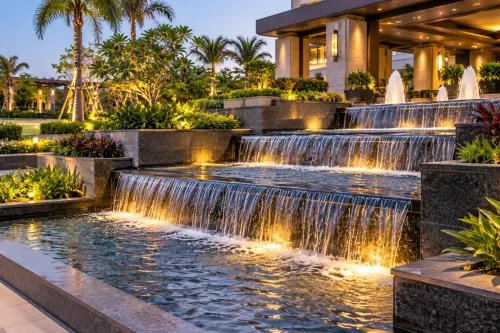
| Pond-based fountain | Existing or designed basin with equipment access | Gardens and large landscapes; unsuitable where excavation or open water creates a hazard |
In a healthcare setting, review any decorative fountain with infection-prevention personnel because recirculating water generates aerosols. Outdoors, choose a lower, solid-stream pattern or sheltered position when wind could carry droplets into walkways; a larger basin alone will not solve unsafe drift.
Check the Water Circuit, Pump and Electrical Requirements
Confirm the water circuit before comparing finishes or nozzles. A recirculating fountain needs a reservoir sized beyond the visible water volume: allow for pipe and filter contents, evaporation, splash-out, and displacement by stones or internal structures. A low operating level exposes the pump inlet and causes air ingestion.
| Water arrangement | What to confirm | Main risk |
|---|---|---|
| Recirculating fountain | Reservoir capacity, refill access, strainer, filter and treatment plan | Biofilm, mineral deposits and pump damage |
| Direct-water installation | Supply pressure, flow rate, drain route, backflow protection and overflow path | Poor nozzle performance or uncontrolled discharge |
| Pond-connected feature | Pond level range, intake screen, pipe length, isolation valve and winter drain points | Debris blockage, low water and hidden pipe freezing |
Select the pump from its performance curve at the system’s total dynamic head, not its maximum-flow figure. Include static lift, pipe and fitting friction, filter and valve losses, and nozzle pressure; a pump rated for the required flow at zero head can underperform after installation.
Treat the fountain as wet-location equipment and confirm these provisions with the electrical designer and local authority:
- A disconnecting means, grounding, bonding and ground-fault protection.
- Correct enclosure ratings and separate listing requirements for pump, lighting, controls and receptacles.
- Protected cable routes, service access and equipment locations away from standing water.
- Drain points or removable components for the basin, pump, valves, filters, manifolds and buried lines before freezing.
For public routes, check gratings, covers, nozzle heads, edges, splash and level changes against accessibility and walking-surface rules. Specify water treatment by material compatibility, dosing control and bleed-and-fill procedure, not chemical name alone.
Choose the Water Pattern, Sound Level and Safety Features
Choose the nozzle type by matching the water pattern to wind, viewing distance and nearby people. Set jet height and spray diameter below the area where droplets could reach walkways, seating, food or electrical equipment; add splash control rather than increasing pump power when drift is the problem.
| Pattern | Sound and wind behaviour | Suitable setting |
|---|---|---|
| Solid stream | Clear sound; lower drift | Outdoor plazas and windy sites |
| Aerated jet | Louder, softer-looking plume; high drift | Sheltered gardens and visual displays |
| Laminar or sheet flow | Quieter, controlled fall | Indoors, entrances and close viewing |
Lighting should reveal the water without shining into drivers’ or visitors’ eyes. Use adjustable, glare-shielded fixtures and place drivers where operators can reach them without entering the reservoir.
Select materials together with the treatment plan. Chlorine or other oxidizers, incorrect pH, algaecides and hard-water minerals can damage stainless steel, seals, stone, coatings and light housings; request written compatibility information and a dosing and cleaning procedure.
For a public route or plaza, specify safety features that prevent the following failures:
- A low-water cutout stops the pump when evaporation, splash-out or blocked makeup water exposes the intake.
- Flush gratings, covers and nozzle assemblies prevent trips and protrusions; keep changes in level outside the walking line.
- Safe access reaches filters, valves, drains, sensors, lights and controls without dismantling the feature.
- Controls provide low-level protection, restart behaviour after power loss, freeze protection where needed and a manual maintenance override.
Estimate Climate Exposure, Maintenance and Total Cost
Budget for recurring labour, water, electricity, treatment and replacement parts, not only the purchase price. Wind exposure increases evaporation and splash-out: aerated or fine-droplet patterns waste more water than solid-stream or low-profile designs, so reduce plume height, enlarge the catch basin or use wind controls instead of simply fitting a larger pump.
- Hard water leaves scale on nozzles, basin surfaces and pump components; plan descaling and inspect flow performance.
- Algae control requires scheduled cleaning and water treatment, especially where sunlight warms stagnant sections.
- Pump and filter cleaning creates routine labour; blocked filters reduce flow and can overheat the pump.
- Include costs for makeup water, lighting, sensors, seals, drivers and occasional pump replacement.
Select equipment that operators can reach without dismantling the feature. Provide safe access to pump baskets, filters, valves, drains, level sensors, lighting drivers and control panels; concealed equipment that requires specialist labour can make a small fountain more expensive over its life.
Specify a low-water cutout to stop the pump when evaporation, splash-out or a blocked makeup line lowers the level. Timed or sensor-based controls should provide restart behaviour after power loss, freeze protection where applicable, pump and lighting scheduling, and a manual override for maintenance. These controls prevent dry running and shorten fault-finding time.
In healthcare settings, add infection-prevention review because decorative fountains generate aerosols and require documented cleaning, treatment and drainability.
Verify the Specification and Plan a Serviceable Installation
Request a coordinated equipment pack before approving the purchase. It should show the overall dimensions, operating water level, reservoir capacity, pipe routes, access panels, drain and overflow points, and the clearance needed to remove the pump and filters.
1. Ask for installation drawings with plan, elevation, section, foundation loads, anchor points, nozzle heights, splash limits and maintenance access. Check them against the site’s measured slab, ceiling, viewing route and service clearances.
2. Require the pump model and power, flow rate, head, voltage, control panel details and cable route. Specify disconnecting means, grounding and bonding, ground-fault protection, enclosure ratings and separate requirements for pumps, lights, controls and receptacles.
3. Confirm the control sequence in writing: startup after power loss, low-water cutout, freeze protection where applicable, pump and lighting schedules, alarm conditions and a manual maintenance override. A basic on/off timer will not protect a pump from evaporation, splash-out or blocked makeup water.
4. Size the reservoir for pipe and filter volume, evaporation, splash-out and displacement from stones or internal structures, not just visible water. For a public route, check gratings, covers, edges, nozzle assemblies and level changes for slip, trip and accessibility hazards.
5. Obtain the water-treatment method, dosing and bleed-and-fill procedure, material-compatibility limits and cleaning schedule. Royal Fountains & Equipments - 08043694426 can be asked to place these service details alongside the equipment drawings, so the operator receives one usable handover record.
Related products
 | Table Top Fountains this fountain perfectly crafted with combination of durable poly resin, stone powder and fiber glass for lasting quality creates a realistic, natural... View product → |
 | Artificial Waterfalls We offer an exuberant range of Fountain Waterfall that are built in round form. View product → |
Frequently asked questions
How do I choose a fountain size for my space?
Measure the usable length and width, ceiling clearance, viewing distance and splash zone. Reserve clear access to the reservoir, pump and drain.
What pump and electrical details should I check?
Confirm the pump flow rate, head height, voltage, wattage, water capacity, cable route, isolator and protection against water exposure.
How do I choose the right water pattern and sound level?
Select the pattern according to viewing distance, available height and splash control. Test the sound level against nearby seating, offices, homes or neighbours.
What maintenance and climate factors affect fountain cost?
Account for evaporation, algae, mineral deposits, debris, freezing or intense heat, filter cleaning, water replacement, drainage and access for pump repairs.
Related products
 | Artificial Waterfalls Our domain expertise allows us to offer an enticing range of Garden Waterfalls. View product → |
 | Indoor Decorative Fountains Tabletop fountain welcomes peace happiness serenity in home. It is made of a durable and lightweight poly-resin but with a ceramic look finish. View product → |
 | Fountain Nozzle The Fountain Nozzle is major part of the system that determines the overall pattern of the fountain. View product → |
 | High Foam Jets Fountains We bring forth for our clients a superior quality range of High Foam Jets Fountains which is creatively designed by our designers using high-grade... View product → |