
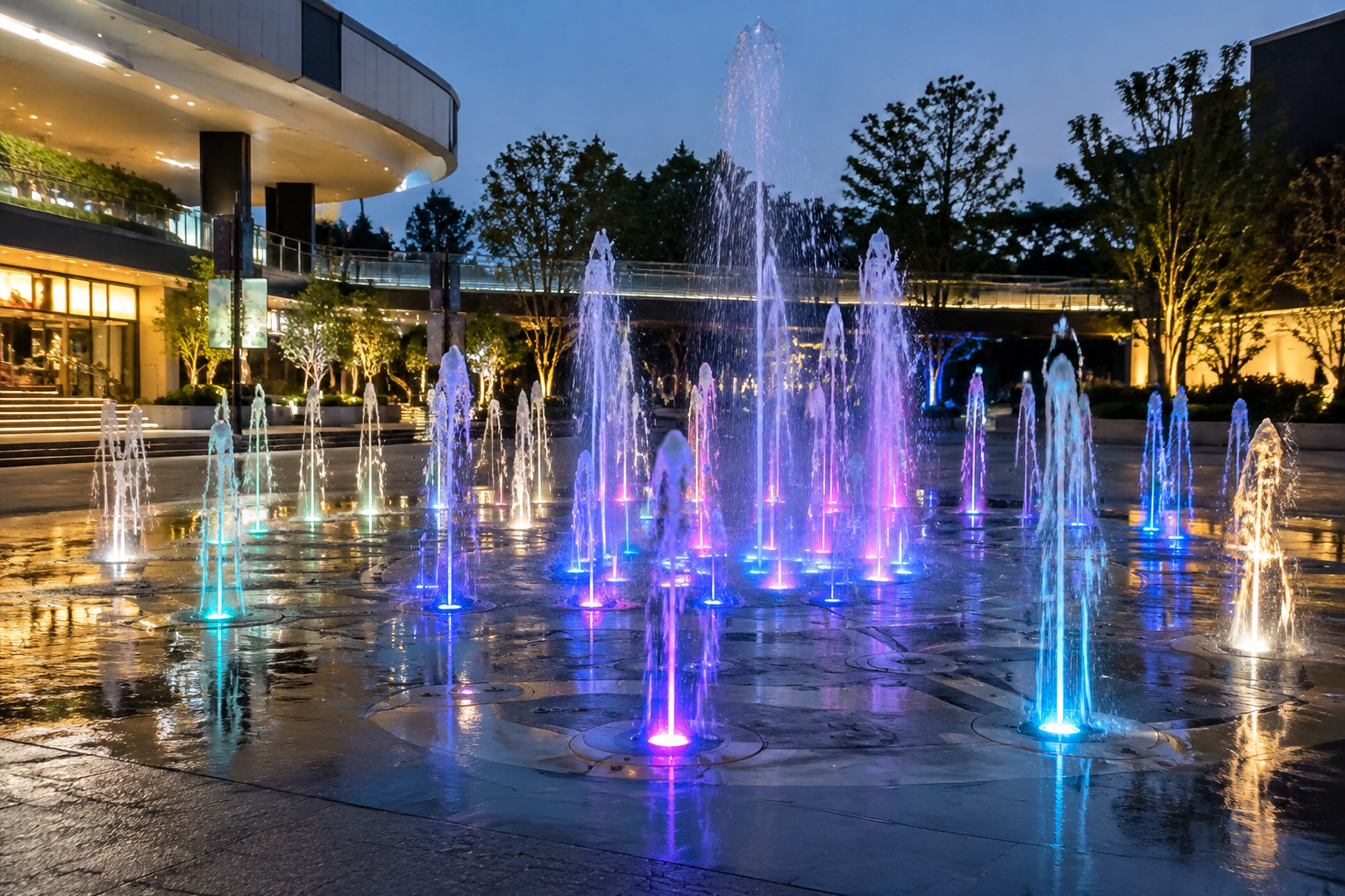
Interactive fountains create a different relationship between people and water. Instead of being viewed only from outside a basin, these installations can be designed to make moving water a more engaging part of plazas, recreational environments, amusement spaces, and public landscapes.
Because people may be much closer to the water effects, planning requires careful coordination.
Define the Interaction Concept
The term interactive fountain can cover different experiences.
Some projects use ground-level jets that activate in patterns. Others create changing sequences intended to attract visitors visually. Larger recreational installations may combine multiple jet zones with lighting and programmed effects.
The design team should first define what visitors are expected to do around the feature.
This affects practically every later decision.
Study Pedestrian Movement
Interactive fountains should fit naturally into the surrounding circulation.
Designers need to understand:
- Main approach directions
- Expected visitor numbers
- Nearby seating
- Entry and exit routes
- Adjacent landscaping
- Vehicle separation
- Drainage paths
For public and recreational projects in Coimbatore, the fountain should enhance movement through the site rather than creating congestion.
Select Appropriate Water Patterns
Different nozzle arrangements produce very different experiences.
Individual vertical jets can create clear rhythmic patterns. Multiple rows can define corridors of water. Varying jet heights can make the display more dynamic.
The water effect should be designed around the available footprint and intended audience.
High-pressure or poorly positioned patterns may not be appropriate in areas where people are expected to approach closely.
Give Drainage Serious Attention
Water management is fundamental.
An interactive installation must return water efficiently to the circulation system while preventing unwanted accumulation in surrounding areas.
Surface levels, collection points, drainage capacity, and surrounding paving should therefore be coordinated with the fountain design from the beginning.
Trying to solve drainage after civil construction can create unnecessary complications.
Consider Surface Conditions
Where visitors can approach or move through a water feature, surrounding surfaces deserve careful evaluation.
Materials should be selected with wet operating conditions in mind. Changes in level, projecting components, and poorly positioned fixtures should be minimized within active areas.
The fountain specialist, architect, landscape designer, and civil contractor should coordinate these details.
Plan Water Management
Interactive fountains can experience higher exposure to environmental contaminants than enclosed decorative fountains.
The circulation and filtration approach should reflect the size of the installation, operating pattern, environmental exposure, and applicable project requirements.
Routine inspection and maintenance procedures should be established before the feature begins operation.
Integrate Lighting Carefully
Lighting can make interactive fountains highly visible during evening hours.
Individual jets can be illuminated, or lighting can follow programmed water sequences. However, fixtures should be positioned and specified appropriately for the environment.
The objective is to enhance the water movement without introducing unnecessary glare or maintenance obstacles.
Provide Technical Access
Pumps, valves, filtration equipment, control panels, electrical systems, and other components need suitable service access.
Public-facing areas may require equipment to remain concealed, but concealment should not prevent technicians from performing routine maintenance.
Royal Fountains & Equipments in Coimbatore works in fountain manufacturing for varied landscape applications, where customized water patterns can be considered according to project needs.
Before finalising interactive fountains, project teams should review user movement, hydraulics, drainage, surface conditions, filtration, controls, lighting, and maintenance as one system. When these elements are coordinated early, interactive water can become an engaging and practical feature within public, institutional, hospitality, or recreational landscapes.
Keywords


