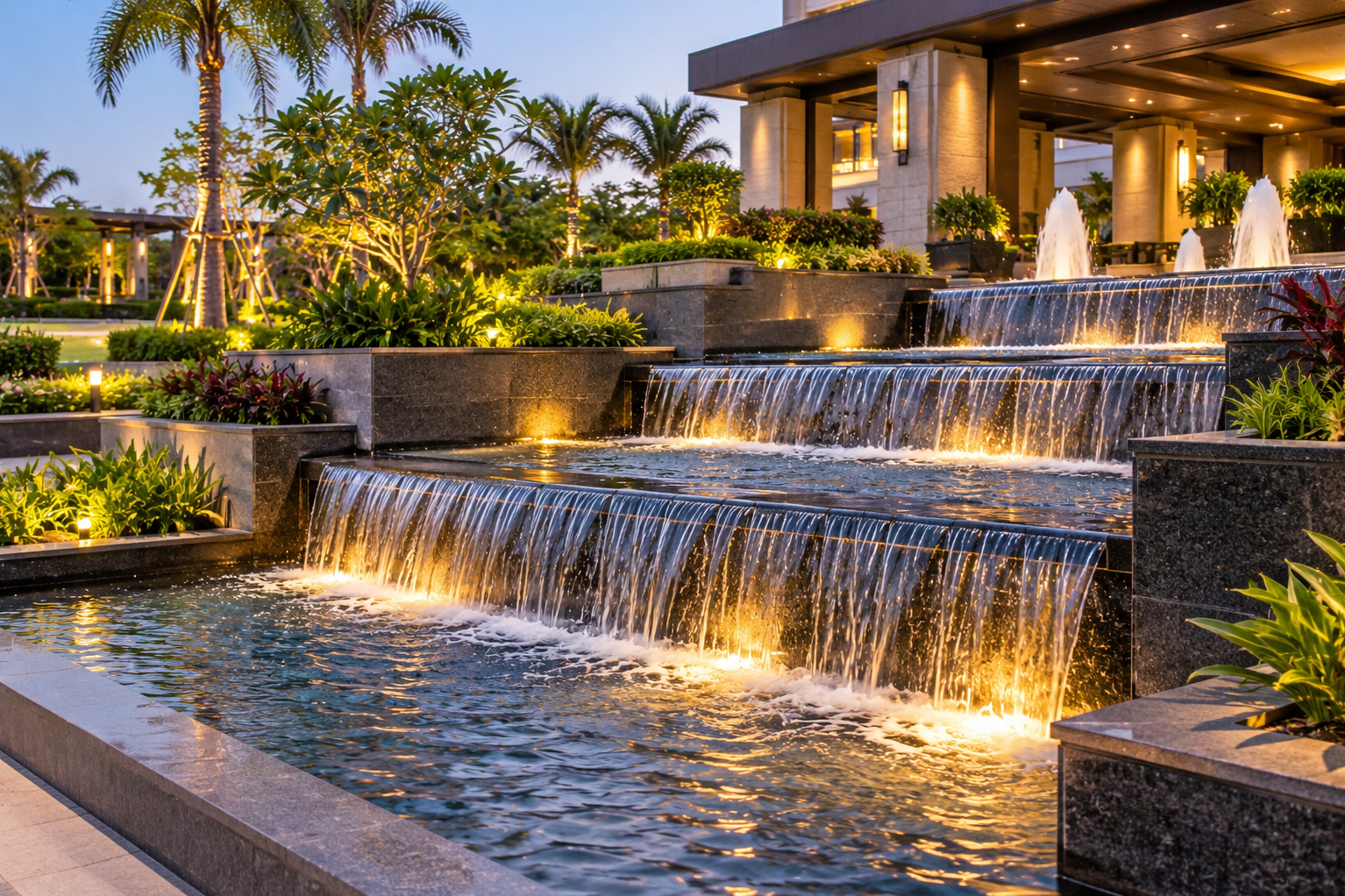
The visual appeal of cascade fountains comes from gravity-driven water movement. Instead of relying primarily on tall jets, these features allow water to flow from one level or surface to another, producing continuous movement and a distinctive water sound.
For hotels, resorts, commercial landscapes, institutional properties, and residential developments in Coimbatore, cascade designs can be particularly effective where the desired atmosphere is elegant rather than highly dramatic.
Decide What Type of Cascade Suits the Space
Cascade fountains can take many forms.
Water may descend over multiple steps, flow across a broad edge, pass between different levels, or combine cascading sections with jets.
The choice depends on the architectural style and available area.
A contemporary property may suit a clean sheet-like fall, while a landscaped resort garden might benefit from a more natural-looking stepped arrangement.
Evaluate the Height
Greater falling height generally changes both visual impact and sound.
A taller cascade can create stronger movement and more noticeable water sound. A shallow stepped feature produces a gentler effect.
Hotels should consider where guests will sit, walk, dine, or sleep in relation to the fountain. A dramatic waterfall may work beautifully at an entrance but be less suitable immediately beside a quiet seating zone.
Check Water Distribution
An attractive cascade depends on consistent water delivery across the intended edge or surface.
Uneven flow can make a wide feature appear incomplete.
The pumping and distribution system should therefore be designed according to the width, height, and required thickness of the water flow.
This becomes particularly important for long architectural cascades.
Select Appropriate Finishes
The material behind or beneath flowing water becomes part of the visual experience.
Stone can create a natural character. Smooth architectural finishes can produce a contemporary appearance. Metal elements may suit modern commercial environments.
Designers should consider how materials look when wet, how they respond to continuous water exposure, and how easily surfaces can be cleaned.
Think About Splash
Falling water can create splash depending on drop height, landing surface, wind, and flow rate.
The receiving basin should be proportioned accordingly.
This is particularly important near hotel entrances, pedestrian paths, restaurant seating, reception areas, and other spaces where uncontrolled water could create inconvenience.
Review Lighting Options
Cascade fountains can look particularly effective with carefully positioned illumination.
Lighting can reveal the texture of moving water and highlight the surfaces behind it.
Rather than using excessive brightness, designers can use lighting to define the edges and depth of the water feature.
Know When the Project Is Ready for Manufacturer Input
A fountain manufacturer can provide more meaningful technical recommendations when key site information is available.
Prepare:
- Site dimensions
- Fountain location
- Desired cascade width
- Approximate fall height
- Architectural drawings where available
- Material preferences
- Lighting expectations
- Pump location
- Operating schedule
For projects in Coimbatore and elsewhere in Tamil Nadu, sharing this information early can also help coordinate civil and electrical work.
Royal Fountains & Equipments operates from Coimbatore in the fountain manufacturing and landscape equipment segment, serving applications where water features may need to be adapted to different project environments.
Choosing cascade fountains should ultimately involve more than selecting an attractive waterfall image. Water distribution, drop height, sound, splash control, materials, lighting, basin design, and maintenance all influence the finished installation. When these factors are considered before construction, cascade water features can become refined architectural and landscape elements.
Keywords