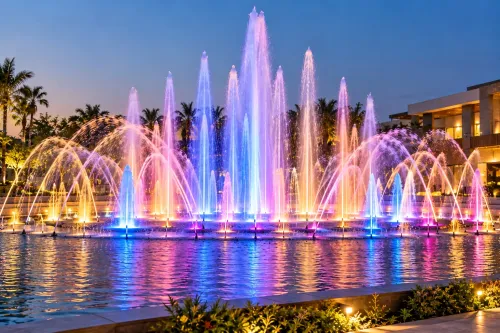
A musical fountain is a timed control system in which audio cues become valve movements, pump changes and lighting commands, while recirculated water completes the loop. By following the signal path, hydraulic limits, electrical safeguards and commissioning stages, you can judge whether a proposed fountain will produce precise musical movement or only a loosely audio-reactive display.
Key takeaways
- Use a shared timeline to synchronise audio, pumps, valves and LEDs.
- Match nozzle, pump and valve response times to the planned choreography.
- Use underwater LEDs with correct beam angles, colour control and sealing.
- Test water quality, wind limits and fault shutdowns before opening the show.
How a musical fountain turns a soundtrack into commands
An audio track does not directly move a water jet. The musical fountain control system reads the track against a shared timeline, then sends commands that specify when a pump changes speed, a valve opens, or an LED fixture changes colour and brightness.
A typical sequence works like this:
- The show designer places beat markers, musical phrases and time-coded cues beside the audio track. The file may carry MIDI or DMX instructions, while a live audio-reactive controller responds to amplitude or frequency in real time.
- A sequential control panel receives those cues and distributes them to pump drives, valve outputs and lighting controllers. It also records safe responses if communication fails.
- A valve or small pump changes flow through a selected pipe. The nozzle converts that flow into a vertical jet, fan, ring, plume or other shape; an LED fixture illuminates the water as it rises.
- The water falls back into the basin, passes through strainers and filtration, and returns to the pumps for the next cue.
Pump speed changes suit broad height or intensity changes, but acceleration and hydraulic inertia make a large pump slow for a sharp accent. Individually controlled valves create quicker patterns, though each valve adds plumbing, wiring and pressure loss.
Nozzle design, pipe diameter, pump head, flow rate and valve response must match, or a jet will miss its cue.
The phrase live audio reactive control projectors describes a different approach: real-time sound analysis driving visual equipment rather than a fully choreographed fountain.
How valves, pumps and nozzles create timed water movement
Jet height comes from flow and pressure at the nozzle, rhythm from timed valve and pump commands, and shape from nozzle geometry. A controller sends time-coded cues to solenoid valves and pump drives. Each valve admits water to one effect or group, while pump speed changes the flow available to several outlets.
A variable-frequency drive adjusts centrifugal pump speed, but acceleration, hydraulic inertia and its programmed ramp time can blunt a sharp accent.
| Control method | Main change | Best use | Response limit |
|---|---|---|---|
| Solenoid valves | Opens or closes a water path | Crisp starts, stops and rhythmic accents | Pressure changes can cause a transient |
| Variable-frequency drive | Changes pump speed and shared flow | Broad height changes across an effect group | Ramp time is slower than a fast valve cue |
| Electronically commutated pump | Changes a small pump’s output directly | Independent, rapid jets | Each assembly serves a limited flow range |
| Nozzle geometry | Forms the stream, spray or plume | Selecting height, width and visual texture | It cannot compensate for an unsuitable pump |
Do not select a nozzle by diameter or catalogue height alone. Match its required flow to a pump operating point at the required total dynamic head, including static elevation, pipe friction, fittings, filters and valve losses. Aerated spray nozzles make broad, wind-sensitive droplets; laminar and smooth-jump nozzles preserve a coherent stream.
One large pump cannot reproduce every musical accent because its pressure is shared and its motor cannot change instantly without a ramp or pressure shock. Use individually controlled valves, smaller pumps or both for precise cues; keep suction free from vortices and air, or fluctuating supply will make even a correct design miss its height.
How underwater LED lighting makes the water visible
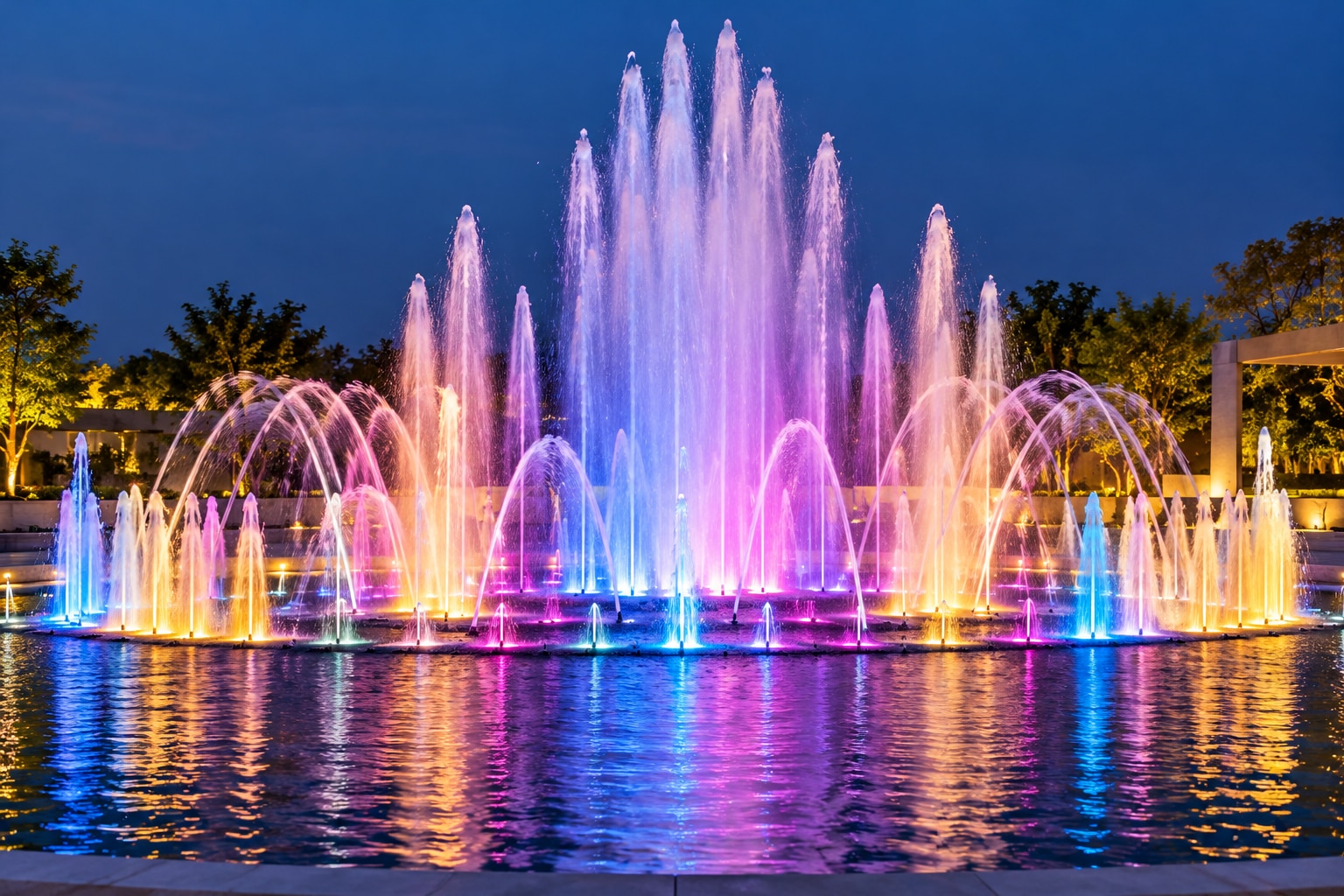
Submersible LED fixtures make a jet visible by sending light into water, not by illuminating a solid surface. Water transmits and refracts the beam, while bubbles and droplets scatter it toward viewers.
Match the beam angle and fixture position to the nozzle: a narrow, coherent stream needs a tightly aimed beam and dark background; an aerated spray accepts wider coverage but creates more glare and spill light. These two water effects need different optical layouts.
RGBW fixtures mix red, green, blue and white emitters, producing saturated colours and a cleaner white. Cue software sends intensity and colour commands through DMX512-A, which carries up to 512 control slots on one link. Use correct polarity, suitable cable, daisy-chain topology and line termination.
Star wiring through passive splitters, missing termination or unsuitable cable can make lights flicker even when the cue is correct.
IP68 covers dust protection and continuous immersion under the manufacturer’s stated conditions; it does not prove shock protection, chemical resistance, cable-gland performance or safe operation at a chosen depth. Before energising the system, verify:
- allowable immersion depth and sealed cable glands
- protective earthing and residual-current protection
- low-level or dry-run interlock
- emergency stop and motor-overload protection
On communication loss or a pump fault, the controller should switch lights and pumps to a defined de-energised state, preventing exposed equipment, basin drainage or electric shock.
How a musical fountain is designed, installed and commissioned
A reliable show starts with site measurements, not music programming. Record basin dimensions, available water depth, wind exposure, power supply, drainage route, equipment-room location and the viewing angles before selecting nozzles, pumps or lights.
1. Complete basin sizing and hydraulic calculations. Set the operating water volume and freeboard, then calculate each nozzle’s flow and total dynamic head, including static lift, pipe friction, filters, fittings and valve losses. Check suction velocity, install anti-vortex protection, and keep strainers accessible. Poor suction geometry causes cavitation, noise and fluctuating jet height.
2. Match hardware to the cue. Test whether each valve reaches its commanded position quickly enough for the shortest musical accent; use individually controlled valves or small pump assemblies for fast changes, rather than expecting one large pump and a variable-frequency drive to respond instantly.
Confirm that pipe diameter, nozzle geometry and discharge pattern produce the intended height without disturbing neighbouring jets.
3. Install for service and containment. Provide pump room access for removing strainers, pumps and cable glands without dismantling the basin. Verify drainage and overflow routes so a blocked drain, leaking pipe or overfilled basin cannot flood electrical equipment or empty the operating reservoir.
4. Commission the complete sequence. Test every cue against the timecode, pump operating point, valve response, LED colour change and audio track. Check low-level interlocks, motor overloads, emergency stop, residual-current protection, communication loss and controlled shutdown. Inspect underwater luminaires beyond the IP68 marking: confirm depth rating, cable-gland integrity, chemical compatibility and the applicable installation standard.
A site brief prepared for Royal Fountains & Equipments - 08043694426 should record these test results, not just the final show file. That record makes later troubleshooting far faster.
Related products
 | Musical Fountain Musical fountains are the center of attraction and it can be operated as a show fountain. View product → |
 | We are instrumental in offering a high quality range of Dancing Fountains which is creatively and accurately designed by our skilled professionals. View product → |
How water quality, wind and fault controls protect the show
A basin that looks clear can still damage a show. Suspended solids clog small nozzles and strainers, biological growth discolours water, and water hardness leaves scale on nozzle openings and underwater lenses. Filtration, accessible strainers, controlled dosing and make-up water must be sized for the actual circulation rate, not added as aftercare.
The control system should reduce or stop effects when operating conditions leave the safe range. A level sensor prevents dry running; a pump trip or motor overload removes that pump from the sequence instead of sending a failed command repeatedly.
An anemometer input can trigger lower jet heights, reduced lighting or a show pause before wind blows water onto walkways or electrical equipment.
Use defined responses rather than an abrupt loss of power to every device:
- A low-water signal blocks pump starts and closes valves that could drain the basin.
- A chemical or filtration fault pauses circulation effects and alerts the operator.
- Loss of controller communication freezes or parks equipment in its tested safe state.
- An emergency stop removes hazardous motion and pump power through the designed safety circuit.
- Residual-current protection trips when leakage creates a shock risk.
A controlled shutdown also matters after a valve fault: it must prevent uncontrolled flow, basin depletion and exposure of energised underwater equipment. After a fault, require inspection of the strainers, water level, cable entries and affected pump before automatic restart.
Frequently asked questions
How does a musical fountain turn music into water movements?
Control software places pump, valve and lighting commands on the same timeline as the soundtrack.
What creates timed changes in fountain jets?
Pumps control water flow, valves start or stop individual circuits, and nozzles shape the resulting jets.
How do underwater LED lights make fountain water visible?
Submerged LED fixtures illuminate the jets, with programmed colour and brightness changes matched to the performance.
What is checked when a musical fountain is commissioned?
Commissioning checks choreography, pump and valve timing, lighting, water quality, wind response and fault controls.