A fountain improves a space only when its scale, sound, materials and maintenance demands fit the setting. By the end, you will be able to compare fountain types, plan the installation area, specify the water system and avoid design choices that create noise, splash or recurring maintenance problems.
Key takeaways
- Measure viewing distance, circulation space and ceiling height before choosing fountain dimensions.
- Match the fountain’s materials, lighting and water movement to the surrounding design scheme.
- Plan pump power, drainage, refill access and electrical protection before installation.
- Specify flow rate, sound level, water capacity and maintenance access in writing.
Choose the Fountain Type and Size for the Space
Choose the fountain size and form by measuring the available surface and viewing distance, then check ceiling height and circulation. A feature should read clearly from its main viewpoint without narrowing a route or competing with furniture.
| Type | Space and proportion | Check before choosing |
|---|---|---|
| Tabletop fountain | Small rooms, counters or consoles; suits a decorative fountain for small spaces | Leave tabletop area for controls, cleaning and a dry splash margin |
| Wall fountain | Preserves floor space and uses vertical height | Provide a suitable, water-resistant backing surface and enough viewing distance |
| Freestanding fountain | Works in lobbies, halls and open interiors where floor area is available | Compare basin width and total height with furniture, ceiling height and walking routes |
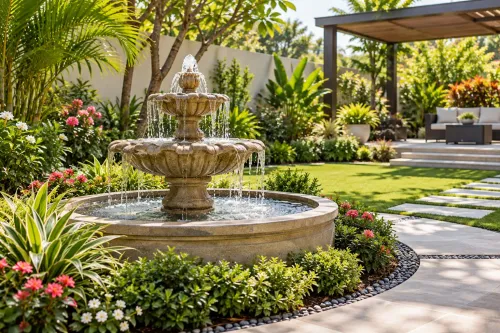
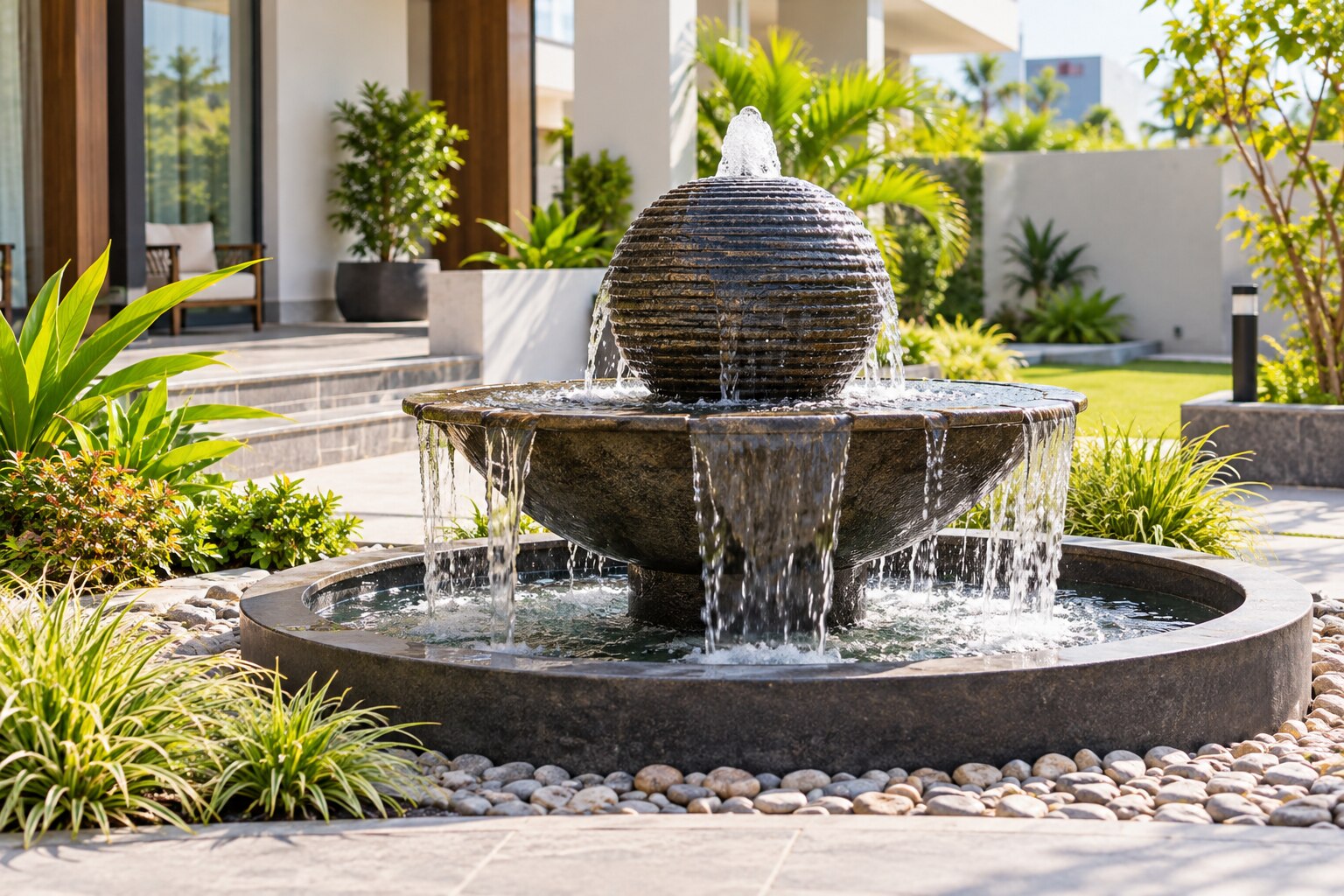
| Garden fountain | Fits courtyards and planted areas | Allow for surrounding planting, maintenance access and wind-driven spray beyond the basin |
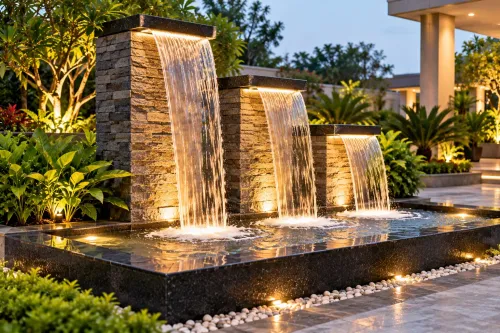
| Artificial waterfall | Suits broad walls, landscape edges or feature backdrops | Reserve adequate wall width, drainage capacity and a visible splash boundary |
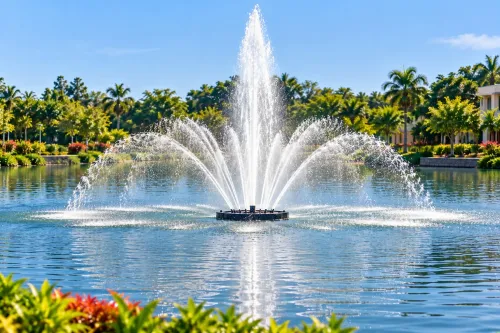
A tall jet can suit a spacious lobby or courtyard, but it can overwhelm a low-ceilinged room and make spray harder to contain. Keep clearance around the basin for walking, furniture movement, pump and filter service, and splash control.
Outdoor planning must extend beyond the basin footprint. Wind drift can wet accessible routes and nearby walls, while plants can block the view or obstruct maintenance; size the feature after marking these zones on the plan.
Match the Water Feature to the Design Scheme
Make the fountain repeat something already present in the space, so it reads as part of the design rather than an unrelated object. Match its form, fountain colour and finish, water movement and materials to nearby walls, paving, furniture or planting.
| Feature cue | Complementary setting | Design effect |
|---|---|---|
| Geometric stainless steel | Clean-lined architecture, glass and concrete | Crisp, controlled focal point |
| Textured stone or natural rock | Planting, timber and an irregular landscape design | Organic cascades that blend into the setting |
| Dark metal or stone | Dense foliage and shaded gardens | Recedes against green; can dominate a small pale room |
| Ornate carving and complex jets | A deliberate feature zone with generous viewing distance | Strong focal point, not background detail |
Decide whether the fountain is a focal point, framing element or background detail before choosing elaborate detailing. A focal point can carry contrast; a framing feature should support the view; background water needs restrained height, movement and finish.
Aim water feature lighting from the side or below rather than straight toward viewers. Test for glare on glass, bright reflections on polished floors and distracting shadows on walls. Warm light around 2700–3000 K suits stone and hospitality interiors, while neutral white around 3500–4000 K can support modern metal and clearer architectural lines.
In commercial spaces, connect fountain design to brand character and customer circulation. Keep spray and reflections away from walking routes, then check the feature at opening, daytime, evening and closing hours—the periods when customers will actually see it.
Plan the Installation Around Water, Power and Access
Before the fountain arrives, prepare a level, water-resistant surface strong enough for its operating weight, a nearby electrical outlet, a fill point, and drainage or spill containment. These are basic fountain installation requirements, not finishing touches.
- Protect the cable routing from foot traffic, standing water, sharp edges and heat. Keep plugs, adapters, junctions and other connection points away from the reservoir, and install residual-current protection or ground-fault protection required by the applicable electrical code. A low-voltage underwater component does not make the complete installation safe or code-compliant.
- Leave enough access to remove the pump, strainer, filter, lights and level sensors without dismantling the basin or surrounding construction.
- For outdoor features, check wind exposure, splash drift, slip-resistant surrounding surfaces, accessible route clearances, overflow discharge and changes in level before fixing the fountain in place.
- In freezing climates, provide drain points, removable components or a documented purge procedure. Water trapped in nozzle bodies, manifolds, filters, check valves, light niches and low points can freeze and split them; include a restart inspection after winter.
Position the fill connection where it can be reached without crossing a wet walking route. Confirm that overflow water cannot run toward electrical equipment, doorways or accessible paths, and make the surrounding surface easy to inspect for leaks.
Control Water Use, Sound and Ongoing Maintenance
Refill frequency reflects more than evaporation. Fountain water consumption includes splash-out, wind drift, leaks and maintenance discharge; room temperature, airflow, pump operation and lighting heat can increase losses.
| Control | Job | Failure prevented |
|---|---|---|
| Float valve | Replaces water at the set level | A low reservoir |
| Low-level cutoff | Stops the pump below safe level | Dry running |
| Overflow | Limits the maximum water level | Flooding from a stuck valve or wind-driven splash |
Specify the pump by its duty point: required flow at total dynamic head. Include static lift, pipe and fitting losses, filter losses and nozzle pressure; maximum advertised flow ignores these demands and can produce a weak plume, noise or overheating.
| Nozzle detail | Record | Why it matters |
|---|---|---|
| Exact model | Manufacturer and model number | Similar-looking nozzles are not interchangeable |
| Operating pressure | Pressure at the nozzle | Determines discharge and plume shape |
| Flow | Litres per minute at that pressure | Sizes the pump and refill capacity |
| Plume height | Stated height and tolerance | Confirms the visual result |
Use water-flow adjustment and splash control to create a soft, audible sheet rather than a wet floor. Pump noise that feels soothing in a garden can become an intrusive hum in an office, bedroom, reception area or restaurant; isolate vibration and test the feature at occupied hours.
Set a cleaning plan for algae control, mineral deposits, stagnant water, odours, strainers and pump impellers. Inspect levels and leaks routinely, remove deposits before they harden, disconnect power before maintenance, and use only cleaning products approved for the fountain materials and treatment system.
Turn the Design Brief into a Reliable Fountain Specification
Approve a customised decorative fountain only after the installer turns the concept into a written fountain specification. Ask for these entries, not a rendering alone:
| Item | Confirm in writing | Failure avoided |
|---|---|---|
| Dimensions and view | Overall height, width, basin size and intended viewing distance | A feature that looks crowded or insignificant |
| Hydraulics | Basin operating level; refill source; overflow route; pump duty point as flow at total dynamic head | Pump starvation, flooding or weak performance |
| Nozzle data | Exact model, operating pressure, flow, plume height and tolerance | An incompatible nozzle or altered spray pattern |
| Noise and splash | Acceptable sound level in dB, measured location, and splash boundary | An intrusive hum or slippery flooring |
| Service design | Maintenance clearances, isolation valves, strainer access and pump-removal route | Draining or dismantling the basin for routine work |
| Protection | Low-level cutoff, winterisation method and the party responsible for water treatment | Pump damage, freeze damage, algae or odour |
For chloride-bearing or coastal sites, ask whether a 316 stainless steel fountain, treated welds, isolation from dissimilar metals and a defined cleaning procedure are appropriate. 316 is not immune to pitting or crevice corrosion.
For underwater fountain lights, require the stated immersion depth, cable-entry method and approved connection system; IPX8 or IP68 alone does not define depth or duration. Include Legionella controls in the water-management risk assessment for healthcare and other high-risk facilities.
Royal Fountains & Equipments - 08043694426 can be compared against this checklist when you need a customised feature; judge the specification, not appearance alone.
Related products
 | Indoor Decorative Fountains Tabletop fountain welcomes peace happiness serenity in home. It is made of a durable and lightweight poly-resin but with a ceramic look finish. View product → |
 | / garden fountain : this beautiful fountains are the most pleasant sight for your eyes, ears & of course for your soul too. View product → |
Frequently asked questions
How do you choose the right fountain size for a space?
Measure the available surface, main viewing distance, ceiling height and circulation route. Choose a feature that remains visible without narrowing walkways or competing with furniture.
How do you match a decorative fountain to an interior or landscape design?
Coordinate the fountain’s shape, materials, finish, lighting and water movement with the existing architectural and landscape scheme.
What installation requirements should you plan before buying a fountain?
Confirm the water source, drainage route, pump location, electrical supply, waterproofing and access for cleaning or equipment repairs.
How can you control fountain water use, sound and maintenance?
Select a suitable basin and pump, specify the desired sound level, include filtration and overflow control, and leave clear access for refilling, cleaning and servicing.
Related products
 | Table Top Fountains this fountain perfectly crafted with combination of durable poly resin, stone powder and fiber glass for lasting quality creates a realistic, natural... View product → |
 | Decorative fountain Decorative Indoor FRP Fountains T his stunning fountain features the serene image of a silver toned Buddha meditating against a wall. View product → |
 | Indoor Fountains Manufacturer This fountain perfectly crafted with combination of durable poly resin, stone powder and fiber glass for lasting quality creates a realistic, natural... View product → |
 | Artificial Waterfalls Our domain expertise allows us to offer an enticing range of Garden Waterfalls. View product → |