A foam display succeeds or fails on hydraulic sizing, water management, site exposure and safe access—not on nozzle height alone. You will be able to judge whether it suits your site, specify the equipment, compare alternatives and check the installation before it is fabricated.
Key takeaways
- Set pool depth from nozzle height, support legs and fitting clearance.
- Size the nozzle, pump, reservoir and drainage as one system.
- Choose fountain types according to users, location and splash exposure.
- Specify water treatment, access panels, emergency shutoff and maintenance points.
Check the Site Before Choosing a Foam Fountain
A foam fountain suits a site only when the structure, water volume, drainage and services can handle its moving spray. Set the required pool depth from the nozzle height and support legs, not from appearance alone; shallow water can expose fittings, destabilise the assembly or create an impact hazard.
- Measure the basin footprint around the operating display, including the full splash radius. Provide freeboard above the normal waterline so startup surges, changing pump flow and wind drift do not flood paving, walls, planting beds or electrical equipment.
- Check the substrate and surrounding structure. Concrete must carry the filled basin, equipment and support legs without settlement; a floating unit needs clearance from pool walls, skimmers and swimmers.
- Confirm pump-room access for isolation valves, filters, drains, controls and lifting space. Sharing a pool filtration pump can change the display when valves move, the filter loads or backwashing starts.
- Plan wet-area electrical safety before the foam fountain installation. Use ground-fault protection, bonding, equipment clearances and enclosure ratings required by the adopted electrical code; United States pool and fountain work commonly falls under NFPA 70 Article 680.
| Site | Conditions to verify | Main failure if ignored |
|---|---|---|
| Pool | Pool depth, swimmer separation, sanitary circulation and drainable pipework | Contact, stagnant water or disrupted filtration |
| Garden | Basin footprint, freeboard, drainage and nearby planting | Overflow, erosion or muddy planting beds |
| Open landscape | Prevailing wind, wind drift, public barriers and lighting | Wet paving, slippery access or spray reaching equipment |
| Commercial site | Service access, lockable controls and documented electrical inspection | Unsafe maintenance and avoidable downtime |
Size the Nozzle, Pump and Reservoir as One System
A zero-head pump rating tells you almost nothing about the finished display. Foam nozzle sizing starts with the required jet height, because the nozzle must entrain air without exceeding its stable operating range; excessive flow creates turbulence, large droplets and splash instead of a taller column.
- Set jet height from the nozzle supplier’s tested flow range, not from pump horsepower. Use the required nozzle pressure head and allow for the loss caused by air entrainment.
- Choose ring diameter from the available footprint and viewing angle. For equal spacing, nozzle count equals the ring circumference divided by the chosen centre-to-centre spacing, rounded up: N = πD ÷ spacing.
- Calculate pump flow as nozzle count multiplied by each nozzle’s tested flow at the target height. Add only genuine auxiliary demand.
- Calculate system head as elevation head plus nozzle pressure head, pipe friction and losses through fittings, filters, valves and strainers.
- Select a pump whose pump curve intersects that flow and system head. Do not use its zero-head flow; the pump must deliver the calculated flow at the calculated resistance.
- Calculate reservoir volume from the operating water level, the basin’s plan area and the water displaced when the pump starts. Add freeboard for wind-driven splash and level changes.
Check the result at minimum and maximum water level. A low water level changes suction conditions and jet appearance, while a narrow basin can overflow when flow shifts or wind pushes the foam column off-centre. Provide an accessible strainer and removable nozzles, since partial blockage shortens or tilts a column before flow stops.
Match the Fountain Type to the Place and the People Using It
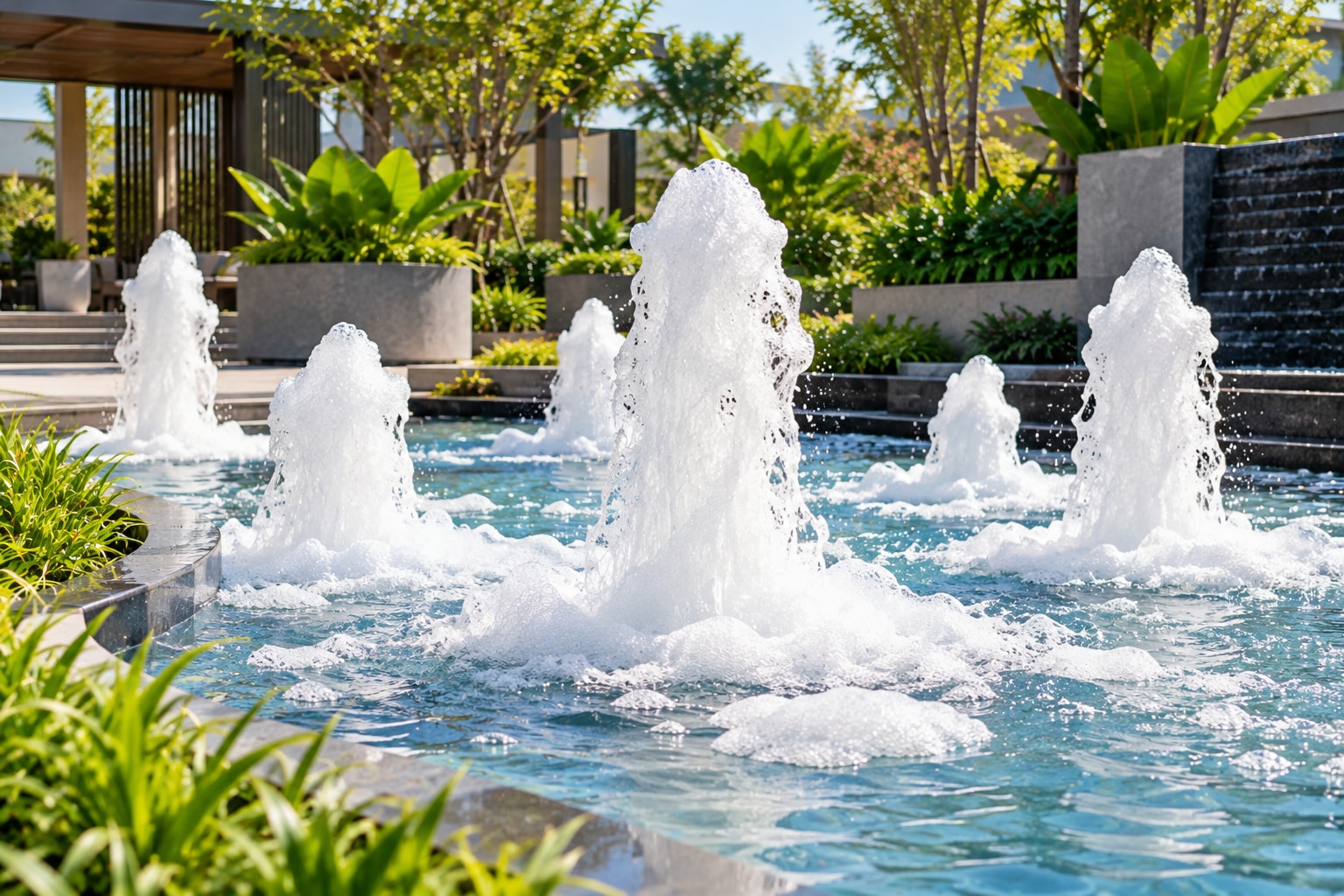
A foam fountain is the better choice when you want a broad, aerated plume with visible movement and forgiving edges, rather than a precise water shape. It suits a swimming pool, pond, or public plaza where viewers value energy and sound over a perfectly controlled silhouette.
| Option | Choose this alternative when | Choose foam instead when |
|---|---|---|
| clear vertical jet | You need a crisp, tall column and formal symmetry | You want a fuller, textured plume that hides minor level changes |
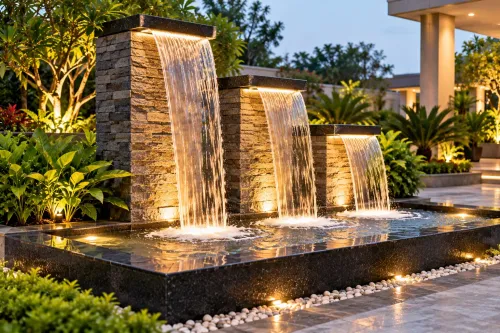
| cascade fountain | A wall, ledge, or stepped channel can carry falling water | The site has no suitable structure or needs upward movement |
| bubbling jet | You want a low dome, gentle sound, and easy access | The display needs more height and visual presence |
| aerator | Circulation and gas exchange matter more than a focal display | You need turbulence that people can see from a distance |
| floating foam fountain | A deep pond needs a movable feature without a fixed base | You need stable placement, concealed services, or controlled sightlines |
| laminar jet | Clean arcs, sharp geometry, and sightlines and photography are priorities | Wind, uneven water levels, or casual public contact make precision fragile |
For an indoor fountain, foam works when its sound and splash fit the room; a laminar jet suits a quiet lobby better. In a pool, connect it to the pool’s sanitary and hydraulic design, not an isolated sump. In any pond or plaza, foam improves circulation but does not make stagnant water sanitary or algae-proof.
Control Water Quality, Maintenance and Everyday Risks
Keep foam consistent by treating the fountain as a recirculating water system, not a self-cleaning display. Check water level, column shape and operating sound at every opening; a shortened or tilted column signals partial blockage before total nozzle failure.
- Isolate power, remove the foam insert and perform nozzle cleaning on the manufacturer’s schedule. Rinse away debris and inspect the orifice for mineral deposits; use an anti-scale treatment approved for the nozzle material, because aggressive acid can damage plating, seals, stone or stainless steel.
- Clean the pump strainer before suction loss causes cavitation or a noisy pump. Specify strainer area and access frequency with the debris load, and use filtration separately; an overly fine strainer can starve the pump while a coarse one can pass particles into the nozzle.
- Test the water and follow one written treatment plan. A pool may require a measured chlorine residual, while an ornamental basin may use a compatible biocide; never assume either regime satisfies the other. Add algae control, manage sunlight and nutrients, and replace water when contamination persists.
- Remove soaps, body products and poorly rinsed chemicals before using defoamer. Persistent foam from surfactants is a water-quality fault, not a nozzle fault.
- Keep hands and feet away during operation, provide non-slip surfaces, and protect electrical circuits with residual-current protection and bonding. Reduce noise by correcting low water level, blocked suction or pump cavitation.
- Secure covers and electrical equipment before heavy rain under a monsoon protection plan. Drain, clean and protect exposed components during winterisation where freezing occurs.
Evaluate the Custom Design Before Fabrication and Handover
Before approving fabrication, require a scaled layout showing the basin footprint, jet envelope, nozzle positions, pump-room route, overflow and maintenance clearance. Mark service access, wall loads, support legs, cable routes, isolation valves and drain points for both fixed versus floating fountain arrangements.
Request this approval pack:
- Hydraulic calculations showing nozzle flow, operating pressure, total dynamic head, pipe losses, reservoir volume, wind allowance and pump duty point.
- Pump data including the manufacturer’s curve at the specified head, motor rating, electrical load, filter pressure loss and control-panel details.
- A witnessed water test at minimum and maximum water levels, recording jet height, flow, pressure, splash, noise, current draw and foam stability.
- A lighting layout identifying fixture wattage, beam direction, cable protection and access for replacement.
- A cost schedule separating fabrication, installation, commissioning, energy, treatment, make-up water, cleaning, replacement nozzles and other operating cost.
- A commissioning checklist, operating instructions, maintenance schedule, as-built drawings, spare-parts list and warranty documents.
Fixed versus floating fountain decisions affect the evidence you need:
| Option | Verify before approval | Main risk |
|---|---|---|
| Fixed | Anchor loads, wall penetration, drain-down and permanent pipework | Settlement or inaccessible equipment |
| Floating | Buoyancy, mooring loads, cable movement, wind drift and retrieval method | Collision, cable damage or unstable jet alignment |
Royal Fountains & Equipments - 08043694426 can be asked to show these calculations and test records against the proposed site conditions, rather than accepting a catalogue photograph as proof of performance.
Related products
 | Foam Jets with Ring Fountain We are one of the leading providers of high quality FoamRing Fountains, which enhance ambiance of the garden. View product → |
 | We bring forth for our clients a broad range of High"Foam Jets Fountains at most economical prices. View product → |
Frequently asked questions
How do you check a site before choosing a foam fountain?
Measure available depth, footprint, drainage, electrical supply, service access and the distance to people or sensitive surfaces. Set pool depth from nozzle height and support-leg dimensions rather than appearance.
How should you size a foam fountain system?
Treat the nozzle, pump, reservoir, pipework and drainage as one system. Confirm the nozzle flow requirement, pump head, operating water volume and refill capacity before selecting equipment.
Which foam fountain type suits a particular landscape area?
Match the fountain’s height, splash pattern, noise and access requirements to the setting and its users. Public areas need stronger control of slip, contact and unauthorised access risks than private gardens.
What maintenance and safety controls does a foam fountain need?
Plan filtration or water treatment, cleaning access, level control, overflow drainage, electrical protection and an emergency shutoff. Inspect fittings, spray behaviour and surrounding surfaces at regular service intervals.
What should you review before a custom foam fountain is fabricated?
Review dimensioned drawings, nozzle and pump specifications, reservoir capacity, materials, service access, drainage, electrical points and operating controls. Confirm testing, commissioning, handover documents and maintenance instructions.
Related products
 | We develop and export a wide range of Foam Jets with Ball Fountain to our esteemed clients. These are easy to install and maintain. View product → |
 | A column of Frothy, aerated water, Recommended for small and medium displays in shallow pools. Beautiful when lighted. View product → |
 | Multiple Floating Jet Fountains Multiple Floating Jet Fountains can be purchased from us in different design options. These fountains eject multiple splashes of water into the air, which look extremely engaging... View product → |