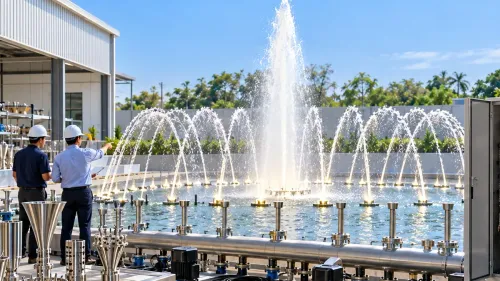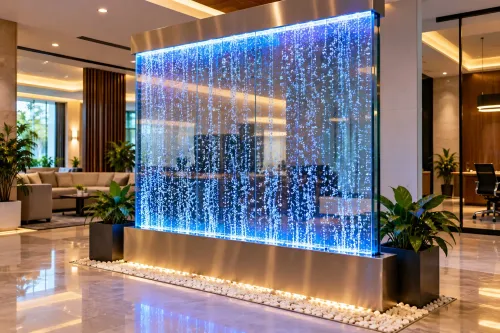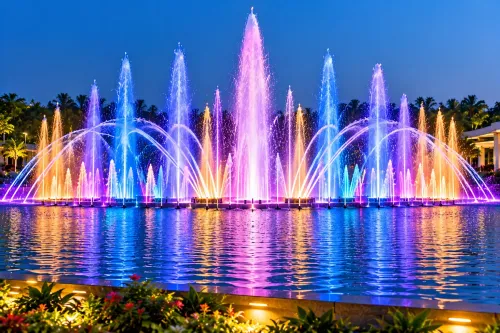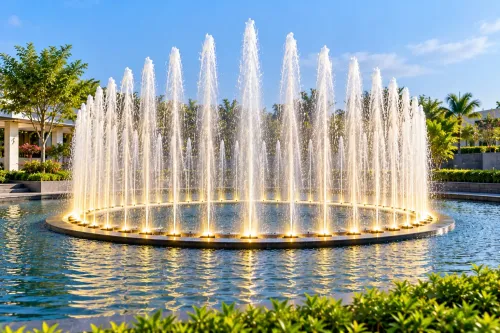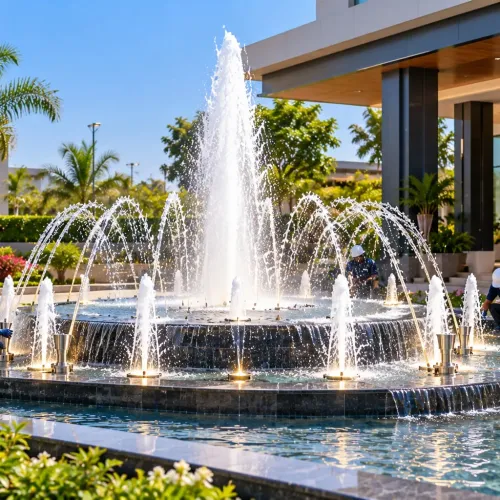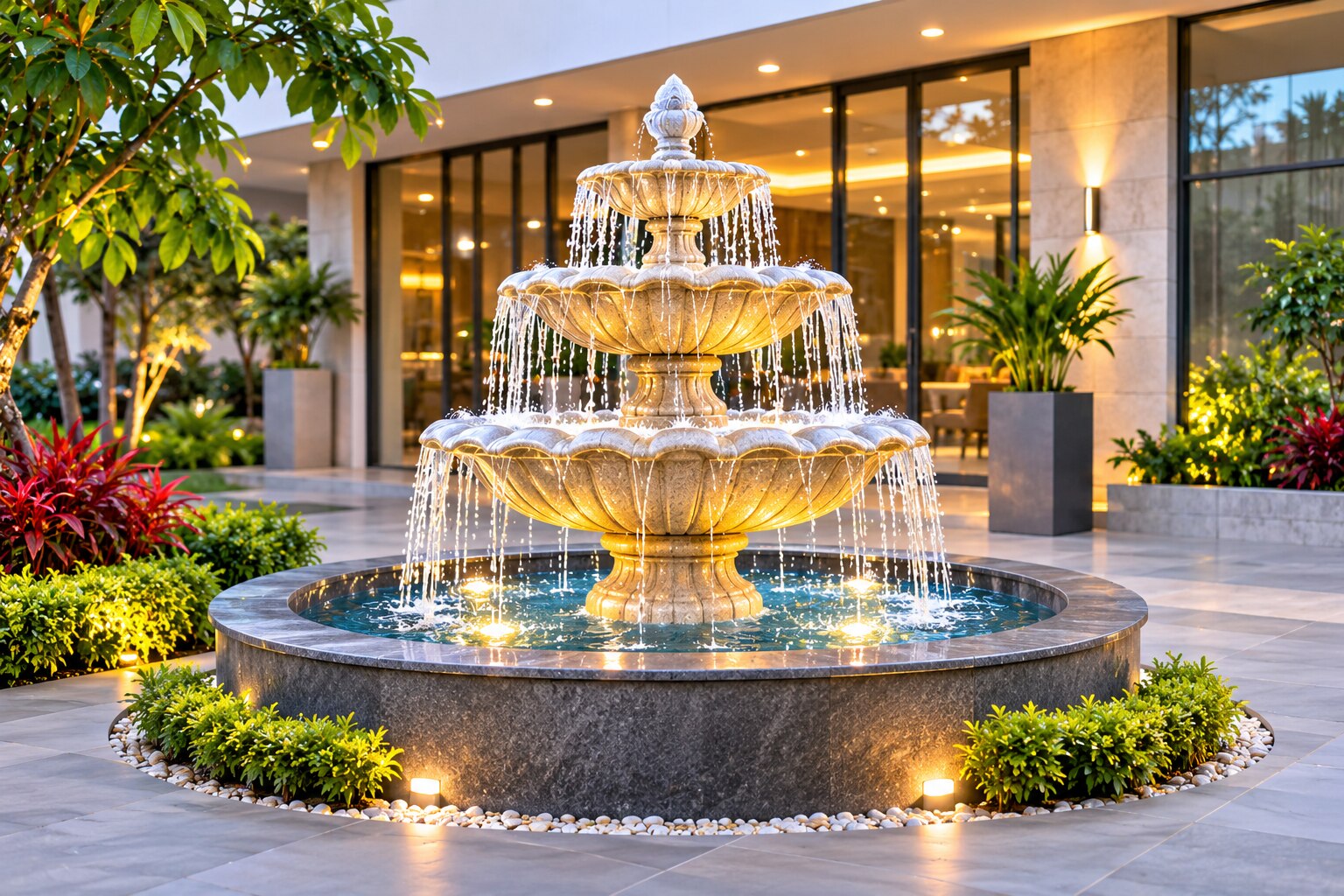
A fountain succeeds only when its water movement, structure, drainage, electrical supply and maintenance access are designed together. By the time you approve a layout, you should know the required footprint, operating load, pump duty point, safety controls, water-quality plan and seasonal maintenance requirements.
Key takeaways
- Measure the basin, equipment cabinet, service clearance and entire splash zone.
- Match pump capacity and nozzle height to water depth, pipe runs and wind exposure.
- Use waterproofing, drainage, earthing and RCD protection before commissioning.
- Design access for filter cleaning, pump removal, water treatment and seasonal shutdowns.
How do you assess the installation site before choosing a fountain?
A fountain installation site assessment starts with the complete fountain footprint, not the basin alone. Measure the available floor, slab, balcony or rooftop area, then add the basin wall, equipment cabinet, service clearance and full splash zone.
Confirm ceiling clearance for vertical jets, wall strength for fountains mounted on masonry or panels, and structural access for lifting pumps, filters or replacement parts.
Before choosing the equipment, check these routes and connections:
- Trace overflow, drain-down and wash water to a planned discharge point; nearby paving or an unplanned floor drain is not a drainage design.
- Locate an electrical point outside the splash zone and map the cable route, isolator and control-panel position.
- Walk the maintenance route from the access door to the pump, filter and tank. A feature that cannot receive replacement equipment cannot be serviced safely.
- Identify whether the feature is decorative, interactive or intended for drinking water.
Use the design basis below:
| Feature | Design basis | Checks before approval |
|---|---|---|
| Decorative basin | Appearance and controlled recirculation | Water-quality plan, stagnation control and drainage |
| Interactive fountain | Aquatic venue under the CDC Model Aquatic Health Code | Circulation, filtration, disinfection, testing and operator controls |
| Drinking spouts | Separate potable and accessibility design | Clear floor space, approach, spout height, flow direction and accessible controls |
An ornamental basin does not satisfy drinking-fountain access requirements, and plaza access does not replace those checks.
Which water system and hydraulic layout fit the space?
Choose between a self-contained recirculating fountain and a plumbed-in fountain before finalising the basin.
| Option | Water arrangement | Strengths and limitations |
|---|---|---|
| Self-contained recirculating fountain | Tank, pump and return loop stay inside the unit | Faster installation, but lower water capacity and tighter access for cleaning or pump removal |
| Plumbed-in fountain | Connects to building supply, drain, make-up line and overflow route | Better control for large commercial installations, but requires coordinated plumbing, drainage and backflow protection |
Size the complete footprint before approving the drawing. Include the basin volume, operating water depth, equipment cabinet, service clearance and splash containment zone; complete a water depth calculation using the actual basin geometry, not its outside dimensions.
Water weighs about 62.4 pounds per cubic foot, or 9.8 kilonewtons per cubic metre, before adding stone, equipment, the basin or people.
A commercial recirculation layout needs surge or balance volume, controlled make-up water, an overflow route, low-level pump protection, drain-down access and a tank-cleaning opening. A pump drawing directly from a shallow decorative basin can vortex, entrain air, starve and produce unstable jets.
Protect potable water from treated fountain water with the air gap or backflow-prevention assembly required by the plumbing code and local water authority. Confirm the hazard classification before connecting a make-up line.
How should you select the pump, nozzles and sound-control details?
Choose the pump at the actual fountain pump duty point, not from its maximum-flow label. Calculate the fountain flow rate and pump head height from static lift, pipe and fitting friction, filter and strainer losses, nozzle pressure, the number of operating nozzles, and pressure loss when filters are dirty.
Compare these pump details before approval:
- Rated flow at the calculated duty point, noise level, power consumption and dry-run protection.
- Safe access to strainers, valves and the pump for isolation, lifting and cleaning.
- A level sensor or float switch that stops the pump before falling water exposes the intake and draws air.
| Nozzle pattern | Main risk | Layout response |
|---|---|---|
| Fine or tall jet | Wind drift can wet glazing, paving, pedestrians or electrical equipment | Check wind exposure, contain splash and keep the jet away from walking routes |
| Wide or low spray | Water can cross the basin edge during pressure changes | Allow a larger splash zone and set overflow capacity |
| Multiple adjustable jets | Unequal pressure or fouling creates inconsistent heights | Balance branches and provide removable, cleanable nozzles |
Account for prevailing pedestrian movement, nearby air movement, nozzle fouling and changing water depth; the catalogue pattern is not the installed result.
Effective fountain noise control starts with system layout. Use resilient pump mounts, flexible connectors, variable-speed drives, separated pipework, baffled returns and overflow drops away from occupied rooms. Ventilate enclosures and provide service clearances: a quiet pump in a resonant cabinet can still transmit structure-borne noise.
What structural, waterproofing and electrical checks are essential?
A qualified structural professional must review any rooftop, podium, balcony, suspended-slab, floor-mounted or wall-mounted fountain for its full operating load and concentrated equipment loads. A fountain structural load includes stored water, the basin, stone cladding, saturated finishes, people and dynamic effects. Waterproofing alone does not prove that the structure can carry the fountain.
- Check fountain waterproofing across masonry, concrete, tile and wall assemblies. Specify a system rated for continuous water exposure, plus a lined or sealed basin and a planned overflow path. A leak can damage finishes below even when the basin itself appears intact.
- For outdoor installations, specify drainable piping, isolation valves, removable nozzles, pitched lines and blowout or vacuum-assist provisions. Exterior lines, low points, filters and light niches can retain water after draining; freezing water can split fittings and crack stone or concrete components.
- Make fountain electrical safety follow the adopted wet-location and fountain provisions of the electrical code, not only the pump manufacturer’s diagram. Ask a qualified electrician and the local code authority to confirm RCD GFCI fountain safety, earthing, bonding, disconnects, underwater-lighting rules, weatherproof enclosures and cable separation.
- Keep electrical joints, junction boxes and control equipment outside the splash zone. Provide a lockable isolation point for maintenance, and keep cables away from water, sharp edges and hot equipment.
How will the fountain remain safe, clean and serviceable after installation?
Write the fountain maintenance plan before construction, especially for hotels, offices, public areas, homes with children or pets, and unattended installations. Assign an operator, inspection frequency, cleaning method and emergency contact.
1. Specify an automatic make-up-water line or a documented manual refill method, a visible overflow route, a fountain water-level sensor, low-level pump shutdown and a safe drain-down route that cannot flood occupied areas.
2. Base fountain water treatment on source-water testing, filtration, disinfectant and pH control. Evaporation, wind and splash-out concentrate minerals; metals, organic debris and hard water then cause staining, scale, clogged strainers and damaged seals. Record testing results and set a partial-drain or blowdown frequency.
3. Apply health-department rules to interactive features, including circulation, filtration, disinfection, testing and operator controls. Decorative fountains still need controls for stagnation, warm water, biofilm and aerosol exposure because Legionella is a public-health risk.
4. Keep filters, strainers, valves, dosing points, sensors, drains, pump lifting points and control panels reachable without removing finished stone. Include drainable lines, isolation valves, pitched piping and a documented fountain winterization procedure for outdoor equipment.
Royal Fountains & Equipments - 08043694426 can help translate these requirements into a customised layout; request duty-point calculations, access drawings, structural coordination, wiring interfaces, water-quality responsibilities and seasonal shutdown instructions rather than accepting a catalogue pattern.
Related products
 | Indoor Fountains Manufacturer This fountain perfectly crafted with combination of durable poly resin, stone powder and fiber glass for lasting quality creates a realistic, natural... View product → |
 | Indoor Fountains We specialize in offering a comprehensive array of Indoor Fountains to our clients across the domestic market. View product → |
Frequently asked questions
How do you assess a fountain installation site?
Measure the full footprint, including the basin, walls, equipment cabinet, service clearance and splash zone. Check slab capacity, drainage, wind exposure, visibility, pedestrian movement and access for installation equipment.
Which water system and hydraulic layout fit the space?
Choose a recirculating system when water conservation and controlled operating costs matter. Size the basin, balance tank, suction lines, return lines and overflow for the intended flow rate, water depth and operating pattern.
How should you select the pump and nozzles?
Select a pump from the required flow and total dynamic head, including pipe friction and nozzle elevation. Choose nozzles for the desired jet pattern, height and sound level, then account for wind and splash.
What structural, waterproofing and electrical checks are essential?
Verify slab capacity, reinforcement, movement joints, drainage and access covers. Specify a compatible waterproofing system, seal pipe penetrations, bond metalwork, provide earthing and install RCD protection through a qualified electrician.
How does a fountain remain safe, clean and serviceable?
Provide filtration, suitable water treatment, safe electrical isolation, non-slip surfaces and guarded equipment. Keep pump, filter, valves, lights and control panels accessible for inspection, cleaning and replacement.
Related products
 | Table Top Fountains this fountain perfectly crafted with combination of durable poly resin, stone powder and fiber glass for lasting quality creates a realistic, natural... View product → |
 | Artificial Waterfalls We offer an exuberant range of Fountain Waterfall that are built in round form. View product → |
 | Artificial Waterfalls Our domain expertise allows us to offer an enticing range of Garden Waterfalls. View product → |
 | Indoor Decorative Fountains Tabletop fountain welcomes peace happiness serenity in home. It is made of a durable and lightweight poly-resin but with a ceramic look finish. View product → |