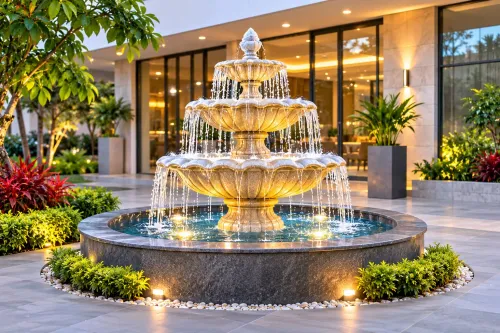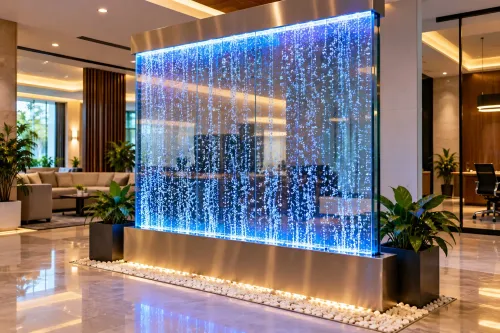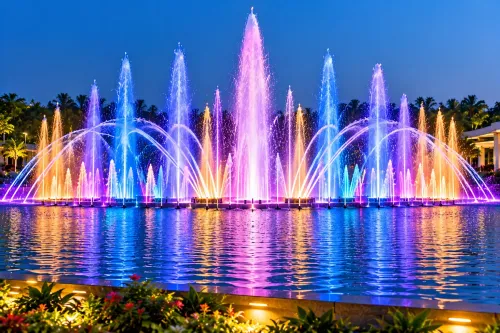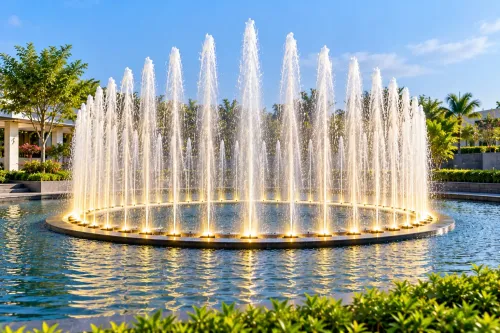
A fountain that looks impressive on opening day can still fail through incorrect pump selection, unsuitable materials, incomplete installation records or weak warranty support. Use the checks below to compare manufacturers, verify technical claims and choose a supplier whose equipment can be operated and maintained over its intended life.
Key takeaways
- Verify the legal entity, workshop address and named engineering staff.
- Request drawings, bill of quantities, pump curves and electrical-load details.
- Check material grades, water-treatment equipment and site-specific durability measures.
- Compare warranty exclusions, commissioning records and response commitments—not headline price.
What does a reliable fountain manufacturer prove before taking your order?
A reliable fountain manufacturer proves its capability before requesting a purchase order. Start with a manufacturer screening checklist covering the legal name, registered address, tax and business details, workshop location, factory capacity and engineering staff by name or role.
- Ask which tasks are performed in-house and which are subcontracted: stainless-steel fabrication, electrical-panel assembly, civil construction and site installation. Subcontracting is acceptable; undisclosed subcontracting creates a handover risk.
- Request dated installation photographs and references for fountains with comparable water volume, climate, water chemistry, operating hours and public exposure. Ask owners about downtime, finish deterioration, replacement-part lead times, winterisation and support after the original installer left.
- Identify the installation supervisor, commissioning technician, technician location and stocked parts. Require part numbers, interchangeability, lead times and an obsolescence policy for pumps, seals, nozzles, filters, valves, sensors, drives and control hardware.
| Evidence to compare | What it proves | What it does not prove |
|---|---|---|
| Factory acceptance record | Fabrication, dimensions, welds, leak integrity, electrical safety and controls were checked | Reliable site performance |
| Site commissioning record | Actual flow, pressure, current draw, noise, sequencing, drainage and water chemistry met limits | Long-term parts availability |
| Client reference | The installation survived real operating hours and public exposure | That your site has identical conditions |
A factory photograph or unqualified warranty claim proves little. A structurally sound fountain can still become unusable when a proprietary nozzle insert or obsolete controller cannot be sourced. Ask for the service response time and warranty responsibilities before comparing prices.
Which technical documents should accompany a fountain quotation?
Do not compare quotations that name only a fountain type, motor size or advertised maximum flow. Require a general-arrangement drawing with basin dimensions, nozzle positions, access zones, equipment locations and maintenance clearances.
The plumbing schematic must show pipe sizes, valves, filters, drains, balancing points and flow directions. Ask for a nozzle schedule listing each nozzle type, quantity, flow rate, operating pressure, height, filtration requirement and cleaning access.
| Document | What it must show | What it exposes |
|---|---|---|
| General-arrangement drawing | Basin, nozzles, equipment, access and clearances | Crowded maintenance zones |
| Pump schedule | Duty flow rate and total dynamic head | An undersized or mismatched pump |
| Pump curve or system calculation | Performance at the actual operating point | Reliance on maximum flow |
| Electrical package | Single-line diagram, load schedule, panel, cables, junction boxes, emergency stop, bonding and earthing | Unsafe or unserviceable controls |
| Commercial schedule | Bill of quantities, material grades, civil-work exclusions and commissioning checklist | Future variation orders |
Total dynamic head must include static lift, pipe friction, fittings, filters, valves, nozzle losses and residual nozzle pressure. Request motor input data at that duty point: a maximum-flow figure measured at little or no head is not a usable rating, and equal-horsepower pumps can produce different pressure and flow.
Request factory and site acceptance records covering leak integrity, electrical safety, controls, actual flow, pressure, current draw, sequencing and drainage. These documents turn missing scope into a question before it becomes a costly variation.
How can you verify materials, water treatment and site durability?
Start with a written material and water specification, not a verbal assurance. Ask the manufacturer to state the grade, thickness, finish and location of every wetted metal component.
Stainless steel 304 versus 316 matters in chloride exposure: 316 or 316L resists it better, but neither prevents pitting or crevice corrosion caused by chlorides, stagnant water, weld heat tint, salt treatment or concentrated dosing.
Require a defined water-treatment envelope listing:
- pH, disinfectant or biocide residual, hardness, alkalinity, conductivity or salinity, temperature and maximum dosing concentrations.
- The procedure or acceptance standard for mechanically finished and chemically passivated welds. ASTM A967/A967M covers passivation treatments; polishing the visible face does not prove that the heat-affected zone was treated.
- For resin or fibreglass parts, the resin system, laminate construction, gel-coat specification and provisions for outdoor UV exposure.
- The basis for pipe thickness, supports and corrosion protection.
For public or potable-water drinking features, require documentation for the complete wetted assembly against NSF/ANSI/CAN 61. NSF/ANSI/CAN 372 addresses lead content separately; “food-grade” or “stainless steel” alone is not equivalent.
Specify positive drainage or documented winterisation for every low point, water trap, pump casing, filter housing and exposed pipe section. A main basin drain cannot empty trapped water in rising pipework. Ask for factory and site records covering leak integrity, welds, controls, actual flow, pressure, current draw, water chemistry and drainage.
How should you compare quotations, warranties and after-sales support?
Put every quotation into the same cost schedule for a reliable fountain quotation comparison, then mark each line included, excluded or provisional.
| Item | Compare in every quotation |
|---|---|
| Equipment | Pumps, nozzles, filters and valves |
| Civil works | Foundations, drainage and civil-work exclusions |
| Waterproofing | Membrane, protection and testing |
| Electrical supply | Incoming power, cabling and isolation |
| Controls | Zones, sensors, variable-speed drives and control functions |
| Transport and installation | Delivery, lifting and site labour |
| Testing and training | Commissioning records and operator instruction |
| Spare parts and maintenance | Initial spares and annual maintenance |
Do not choose on total price alone. Check operating zones, filtration equipment, sensors, variable-speed drives and control functions.
Specify the appearance at the operating condition: allowable splash, wind drift, plume breakup and nozzle-to-nozzle variation. Ask for pressure tolerance, filtration requirements and cleaning access; contamination and pressure changes alter nozzle performance. Confirm design flow, total dynamic head, operating depth, power load, required water level and treatment regime.
Get warranty terms in writing. State the duration, covered parts, labour, start date, maintenance records required, chemistry, dry-running and freezing exclusions, response time and site-visit terms. Clarify who pays freight, access equipment, removal and recommissioning when salt dosing or poor water quality causes damage. A “two-year warranty” can exclude the technician and lifting equipment.
For electrical systems, require the single-line diagram, load schedule, control-panel drawings and as-built control backup. An IEC 60529 IP rating describes enclosure ingress protection, not shock protection, grounding, residual-current protection or local electrical compliance.
What tests and records confirm the manufacturer can deliver?
Do not treat a factory acceptance test as proof of field performance. A factory record confirms what was built before dispatch; a site acceptance test confirms that the installed fountain performs under actual hydraulic, electrical and environmental conditions.
| Stage | Evidence to require | Failure exposed |
|---|---|---|
| Factory acceptance test | Dimensions, fabrication, weld quality, pressure or leak integrity, electrical safety and control-panel operation | Incorrect fabrication, leaks, unsafe wiring or faulty controls |
| Site acceptance test | Actual flow, pressure, current draw, noise, sequencing, water chemistry, drainage and operation after normal temperature is reached | Installation errors, undersized equipment, excessive noise or unstable performance |
Use a commissioning checklist and record each reading, test date, instrument used, acceptance limit, defect and corrective action. Make the warranty operational: name covered parts and labour, start date, response time, chemistry and freezing exclusions, required fountain maintenance records, and responsibility for removal, access equipment, freight and recommissioning.
The handover pack should contain:
- Approved drawings, pump curves, nozzle settings, wiring diagrams and equipment manuals
- Spare-parts list, maintenance intervals, water-treatment limits and winterisation instructions
- Warranty contacts and an as-built control backup
- Training for filter cleaning, nozzle removal, chemical testing, safe isolation, dry-run prevention and fault resets
A supplier such as Royal Fountains & Equipments - 08043694426 should provide comparable references, dated photographs, factory acceptance records, pump and control-panel brands, material documents and stocked-parts information. Select the bidder whose contract sets measurable site criteria and whose records match your hydraulic scale, climate, chemistry, operating hours and public exposure.
Related products
 | Indoor Fountains Manufacturer This fountain perfectly crafted with combination of durable poly resin, stone powder and fiber glass for lasting quality creates a realistic, natural... View product → |
 | Floating fountains are a type of fountain applicable in any water park or lakes. They are a developed version of ring fountains. View product → |
Frequently asked questions
What should you verify before ordering from a fountain manufacturer?
Check the manufacturer’s legal name, registered address, tax and business details, workshop location, factory capacity and engineering staff by name or role.
Which documents should a fountain quotation include?
Request layout and fabrication drawings, a bill of quantities, equipment schedules, pump curves, electrical-load details, control-panel specifications, installation scope and commissioning requirements.
How can you check whether a fountain will withstand its site?
Confirm the specified material grades, coating or finish, electrical protection, drainage, water-treatment system and maintenance access against the site’s weather, water quality and public-use conditions.
How should you compare fountain manufacturers beyond price?
Compare what each quotation includes, warranty exclusions, spare-parts availability, installation and commissioning records, testing procedures, service response commitments and after-sales support.
Related products
 | Garden Waterfalls Royal fountain and equipments is one of the well known designer and manufacturer of fountains and waterfalls. View product → |
 | Sculpture Fountains Being one of the largest manufacturer of fountains we have expanded our hand in the manufacture of Sculpture Fountains with different designs. View product → |
 | A column of Frothy, aerated water, Recommended for small and medium displays in shallow pools. Beautiful when lighted. View product → |
 | Complementing the decor of any place, our exclusive range of Foam Fountains is available in a wide range of designs, colours, sizes and texture... View product → |